
A member of the Winthrop Town Council, Suzanne Swope, testified before a committee of the Massachusetts state legislature, claiming to be speaking on behalf of the town in publicly pushing a politically divisive campaign to reject the state’s 3A housing law.
The council member, Suzanne Swope, addressed the Joint Committee on Municipalities and Regional Government on Tuesday, urging support for a legislative proposal to specifically exempt Winthrop from the terms of the 3A law.
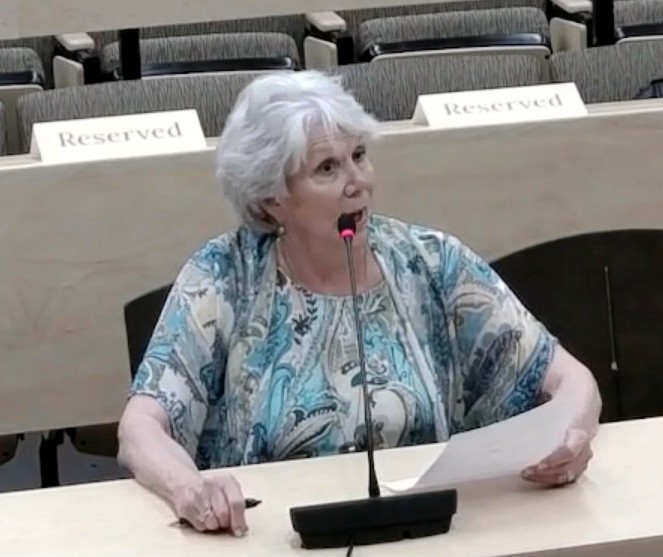
In a two-minute address, Ms Swope said she traveled to the State House “to speak on behalf of the people of Winthrop” about 3A.
While Ms Swope is only one member of Winthrop’s nine-member governing Town Council, and not a designated representative of it, she is the mother of a lead organizer of a lobbying group that has been orchestrating attempts to foment 3A non-compliance throughout the Boston area.
The 3A law is part of the MBTA Communities Law that was passed almost unanimously by the state legislature in 2021. It requires virtually all cities and towns around Boston to expand multifamily housing zoning within their borders, in a bid to ease a crisis of housing availability by allowing new units near rail and bus service.
Winthrop, however, already has three parts of town with large multifamily units, and town leaders have determined that they can comply with the state’s 3A requirement by merely updating the zoning category that governs those three areas to reflect the housing density that already exists there.
And yet the Winthrop Town Council, in response to the lobbying efforts – which have included shouted rebukes at council members during public events – has refused to take that step. The president of the Winthrop Town Council, Jim Letterie, has aligned himself with the anti-3A activists – even while acknowledging that the law they oppose so adamantly would not actually require the town to add any new housing units.
Mr Letterie has defended that stance by repeating the argument of 3A opponents that any show of compliance with 3A would be taken as a weakness that would encourage the state to impose new zoning requirements on towns in the future – despite the fact that the state constitutionally holds the right to set such zoning requirements either way.
And refusing compliance has hard implications for the taxpayers of Winthrop. In an enforcement mechanism typical at both the state and federal level – the 3A law threatens cut-offs in state funding for towns such as Winthrop that refuse to meet its terms. Mr Letterie and other town officials have acknowledged that means his position of violating the 3A law could cost the town’s budget and its taxpayers millions of dollars in legal fees and lost state funding.
The dispute also is raising political tensions in Winthrop, threatening progress on a range of governance matters beyond housing. One member of the Town Council already has resigned, with the council’s remaining eight members unable to agree on a replacement for him. And the group led by Ms Swope’s daughter is currently waging a removal campaign against another member of the Town Council over his position on 3A.
And yet Ms Swope, in her appearance before the state legislative panel, suggested that the state is the party pursuing “a divisive strategy” by refusing to formally grant an even clearer exception to 3A than the town already owns by virtue of its ability to comply without adding any new housing units.
The state legislative hearing on Tuesday lasted some five hours, much of it spent taking two-minute oral comments from interested individuals. Another backer of Winthrop’s anti-3A group, Carole Mietzsch, a technology manager at Boston University, also testified, and also presented herself to the state lawmakers as “speaking for the community” of Winthrop on the 3A matter.
Ms Mietzsch repeated to the lawmakers old estimates that 3A compliance might mean 882 new housing units in Winthrop, even though Mr Letterie and other town officials made clear months ago that their strategy of rezoning three existing multifamily locations – Seal Harbor, Governors Park and the town’s downtown central business district – means the town of Winthrop can gain 3A compliance without building any new housing units.
Both Mr Letterie and the Town Council’s vice president, Hannah Belcher, while on opposite sides of the question of 3A compliance, both acknowledged in recent appearances on the WCAT program Winthrop and the World that they realize that hundreds of housing units already are being built in Winthrop regardless of the 3A question.
Both council members, however, also said that the new housing construction is happening in a way that ultimately should not raise the population of Winthrop significantly beyond its current level of about 19,000, in part because the population is growing older and because units with fewer bedrooms are becoming more common.
“I think that it’s just naturally going to stay in that general area” of 19,000, Ms Belcher said in her appearance on the WCAT program.
 Winthrop Pilot
Your input is welcome. We encourage respectful and constructive dialogue. Comments that contain hate speech, personal attacks, spam, or other inappropriate content will be removed. Repeat violations may result in a temporary or permanent ban from commenting.