
Winthrop residents are facing higher costs for natural gas as the town’s old underground pipeline network deteriorates, and a regional energy expert is predicting that Winthrop’s upcoming construction of a new fire station could help inform the process of finding alternatives.
Natural gas is the most common heating source for homes in Massachusetts, and widespread in Winthrop. The state’s underground service lines also are some of the oldest in the nation, some dating back to the 1800s, meaning many communities face growing repair and maintenance costs. Natural gas pipelines also pose the risk of explosions, and their daily leaks emit methane, a greenhouse gas far more potent than carbon dioxide.
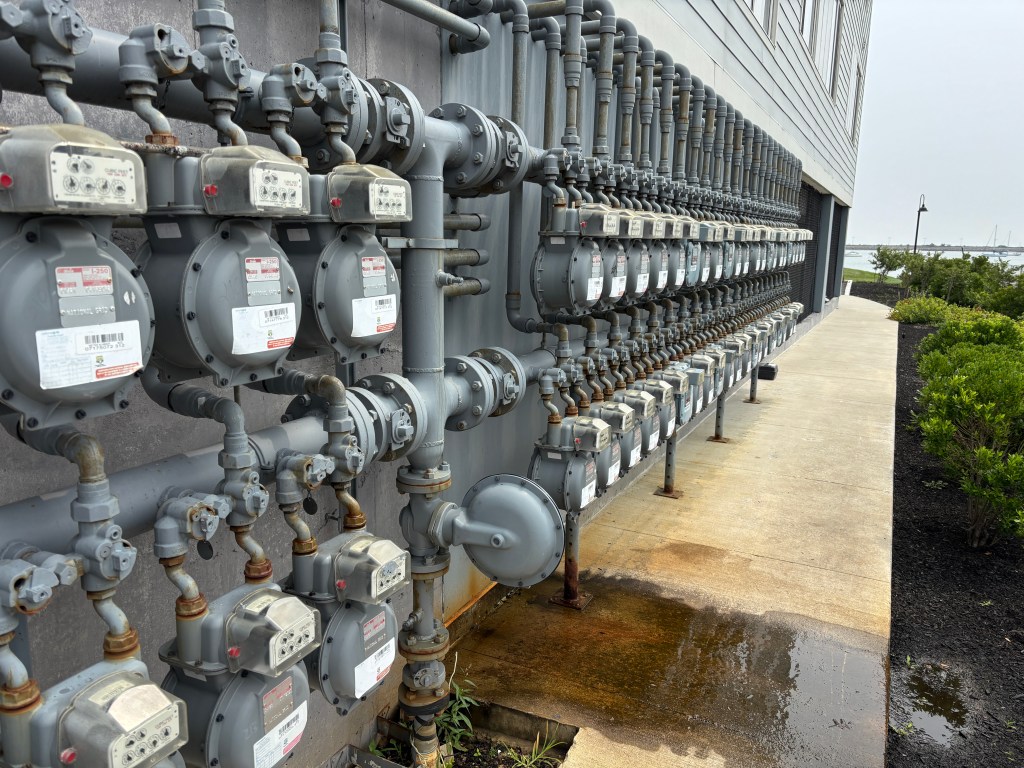
Leading options to replace widespread natural gas reliance include the expanded use of electricity for heating and cooking, and the development of geothermal energy, according to the Building Electrification Accelerator, a nonprofit coalition that helps municipalities in Massachusetts handle such transitions.
A co-founder of the Building Electrification Accelerator, Anne Wright, appeared recently before Winthrop’s Citizens Advisory Commission on Climate to describe the possibilities, including costs and potential timelines.
Transitions away from natural gas can be difficult, both logistically and politically, given that many residents are familiar with natural gas and its popularity in cooking, Ms Wright acknowledged in her presentation to the commission and in a subsequent appearance on WCAT’s Winthrop and the World program.
But when residents understand the full cost of trying to keep natural gas pipelines, both in terms of the looming repair bills and the environmental consequences, they may decide that the chief alternatives are preferable, Ms Wright said.
“There’s no magic fund paying for leaked gas,” Ms Wright said on the WCAT program. “Customers are footing the bill for what essentially never even reaches their homes.”
Winthrop already has at least six neighborhoods of multiple homes where underground gas line leaks are so problematic that the pipelines are scheduled for replacement in the 2026-2028 period, Ms Wright said. But, she noted, experts estimate that the actual number of leaks in any community may be two or three times greater than what’s officially reported.
Towns also are eligible for state and federal assistance to pursue natural gas alternatives. One of the earliest adopters is Framingham, where a geothermal pilot program led by Eversource transitioned a mix of residential and commercial properties off gas entirely. Despite early technical hurdles, the project is considered successful, Ms Wright said, and expansion is already underway with signs of improved efficiency and reduced costs.
Winthrop may get its own detailed examination of the possibilities of geothermal energy from the upcoming construction of its new fire station, which was approved by the town’s voters earlier this year. The Winthrop town committee in charge of the project has made clear it will explore geothermal and other low-carbon or zero-carbon options for heating and cooling the facility.
Geothermal involves drilling pipes deep into the ground, where year-round steady-state temperatures can provide heat in the winter and cooling in the summer. Its practicality depends on factors that include the difficulty of drilling in a particular area and the number of nearby buildings that can be served.
Ms Wright also is affiliated with the statewide chapter of Mothers Out Front, an environmental group that is promoting neighborhood-scale electrification pilots, including one proposed by National Grid for Winthrop. If approved, it could offer participating residents free replacement of their gas appliances with electric alternatives.
The Building Electrification Accelerator and Mothers Out Front have been trying to help residents understand the full cost of sticking with natural gas service. As an example, she said, utilities are obligated to fix dangerous leaks immediately — but they do so a regulatory environment that incentivizes full pipeline replacements over repairs, largely because full replacements are significantly more profitable for utilities, even when repairs would be sufficient and far cheaper for customers.
And while geothermal is still getting explored, existing technologies such as heat pumps – essentially air-conditioning systems run in reverse to generate heat in the winter – already are solid well-established options, Ms Wright said.
“Geothermal might be possible for the fire station,” she said. “But there are many factors — ground conditions, water table levels, and more — that need to be assessed first.”
Among the considerations, geothermal is understood to be more promising when done with a large facility or when a group of buildings can share a system. To that end, the new Winthrop fire station is a potential “teachable moment” for the entire town, Ms Wright said. And while the new federal budget cut out many programs that promoted less-polluting energy options, Congress largely kept funding for geothermal projects, she noted.
Massachusetts state leaders also appear active on such matters, Ms Wright said. Governor Maura Healey has proposed legislation to equitably phase out natural gas and retrain workers for clean energy jobs, and state Senator Cynthia Creem is pursuing legislation that would provide legal and financial frameworks for the transition, Ms Wright said. Also the Massachusetts Department of Public Utilities has just approved a program of lower electricity rates during the winter for heat pump owners.
And nobody will be forced off gas overnight, Ms Wright said. “This is a transition,” she said. “But it’s one we have to make if we’re serious about meeting our 2050 net-zero goals.”
Winthrop is doing well to explore such options now, Ms Wright said. “These technologies are real, they’re here, and they work,” she said. “We just need to make them accessible — and take that first step.”
 Winthrop Pilot
Your input is welcome. We encourage respectful and constructive dialogue. Comments that contain hate speech, personal attacks, spam, or other inappropriate content will be removed. Repeat violations may result in a temporary or permanent ban from commenting.