
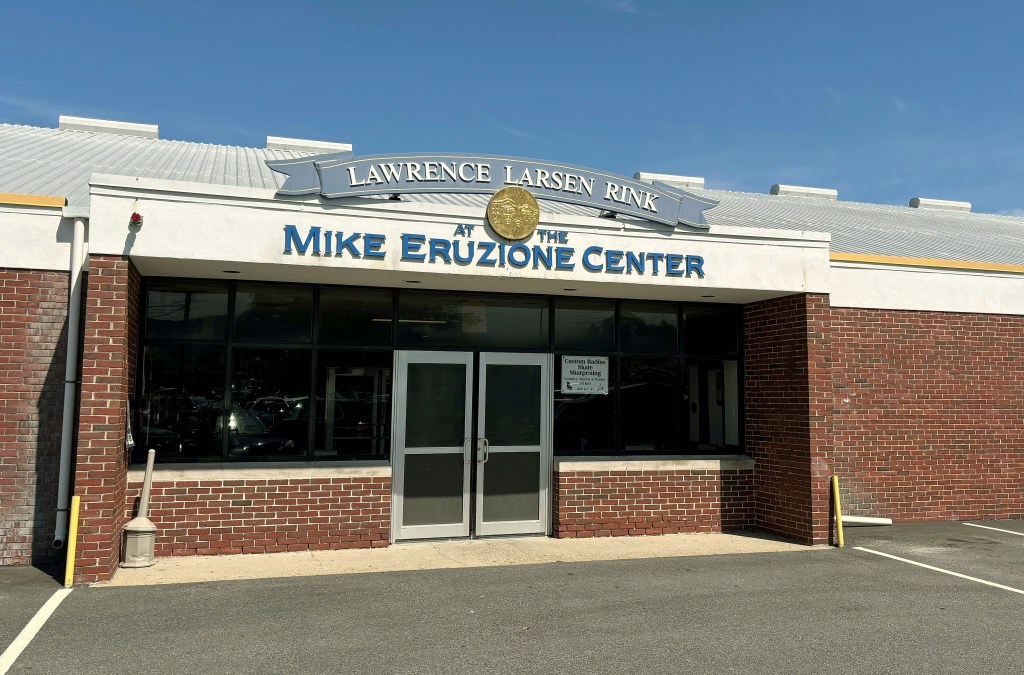
Winthrop Fire Chief Scott Wiley said he’s open to the use of geothermal and other less-polluting options for powering the town’s new fire station, as the nearby Larsen Rink and Donovan’s Beach emerged as possible energy sources.
In a presentation Monday to Winthrop’s Citizens Advisory Commission on Climate, a leader of the Home Energy Efficiency Team, or HEET, a Boston-based nonprofit promoter of sustainable energy transitions, set out a variety of options for powering the $38.5 million fire station project approved by town voters in April.
Some of those options may initially look more expensive than traditional power-grid choices, said Angie Alberto Escobar, HEET’s Gas-to-Geo transition director. A key early task, Ms Alberto-Escobar said, would be to conduct an analysis of the fire station site and the available grant support to understand what options make most sense for the town.
If done well, she said, the fire station could be “a hub for climate resilience” in Winthrop.
Chief Wiley told the Climate Commission he was very willing to learn about such possibilities, but also understood that Winthrop voters approved $38.5 million for the new fire station and that he absolutely did not want to exceed that amount.
“We’re open to looking at this,” he said. “But to be brutally honest, it’s going to boil down to dollars and cents for us.”
The event marked the second straight monthly hearing in which the Climate Commission heard expert testimony on energy options for the town in general and for the fire station project in particular.
Ms Alberto-Escobar explained that Winthrop and many other towns have hard choices either way, because natural gas pipelines across the US face the need for an estimated $1.4 trillion in repairs between now and 2050, and that much of that spending looms as a bad investment as cheaper and less-polluting alternatives gain maturity.
Geothermal generally involves digging pipelines that reach deep underground, where relatively steady-state temperatures can help substantially with above-ground cooling, heating and electricity production. But there are varieties of the geothermal concept, Ms Alberto-Escobar said, that take advantage of other sources of heat, including nearby industrial buildings.
And two examples with particular potential for the fire station site in downtown Winthrop, she said, include the ocean and the skating rink, which often throws off substantial heat as it produces and sustains ice.
Members of the Climate Commission and planners of the fire station project said that timing is critical, as the fire station has a target completion date of early 2028, and some key decisions about its energy sources – especially the possibility of drilling geothermal pipelines deep beneath the facility – need to be made before construction starts in the middle part of next year.
The HEET organization can provide free assistance with planning and grant applications, Ms Alberto-Escobar said. Climate Commission members acknowledged, however, that such work could be hindered by the Town Council’s refusal to comply with the state housing law known as 3A, since non-compliant towns are considered ineligible for many kinds of state financial aid.
The Climate Commission also identified four nearby towns – Acton, Easton, Weston and Northborough – that have incorporated geothermal energy into a fire station project. Commission members plan to learn more about the experiences of those towns as a way of informing Winthrop’s decision.
Ms Alberto-Escobar also suggested that while the fire station project isn’t allowed to exceed the $38.5 million budget granted by voters, the town could pursue financing options based on long-term energy savings, especially if it creates a geothermal system that involves other government buildings or even homes and other private partners.
The idea of using pipelines to the ocean at Donovan’s Beach, in particular, would be such a large project, Ms Alberto-Escobar said, that it would have to involve large sections of the town to generate the necessary cost-efficiencies. “You basically have unlimited renewable energy if you build that pipe to the ocean,” she said.
A much smaller-scale option for just the fire station, Ms Alberto-Escobar said, could be a horizontal version of geothermal energy, that uses pipes installed relatively shallow in the ground but over wider distances. That’s an option that could be plausible in Winthrop because of the town’s relatively large amount of groundwater, she said.
The new fire station also will be built with connections for solar power, even if rooftop panels are not installed as part of the initial construction, Chief Wiley said.
 Winthrop Pilot
Your input is welcome. We encourage respectful and constructive dialogue. Comments that contain hate speech, personal attacks, spam, or other inappropriate content will be removed. Repeat violations may result in a temporary or permanent ban from commenting.