
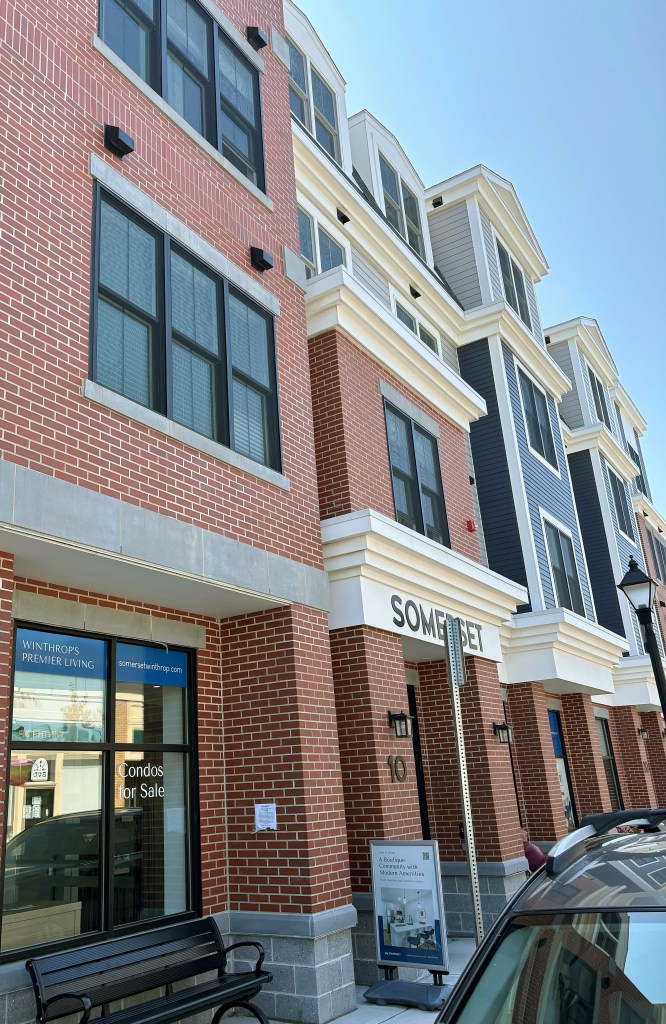
The Somerset apartments in downtown Winthrop is converting from rental apartments to owner-occupied condominiums, in what the owner of the politically charged project calls a reflection of strong demand in the area.
The conversion is occurring only three years after the 29-unit development was built, and it comes amid prolonged and often caustic arguing in Winthrop over bigger-picture questions about the expansion of housing in town.
That battle is only intensifying, with a small cohort of Winthrop activists and outside allies pushing multiple new attempts to void the state’s pro-housing 3A law and to remove a member of the Town Council who has been warning of the financial threat that the rejectionist campaign poses to Winthrop taxpayers.
In the case of the Somerset, the project’s creators insisted that the move to condominiums reflected strength. “The Somerset’s strong occupancy and long-term tenant retention made it clear there was lasting demand for this type of product,” Bryan Vitale, the senior vice president of strategy and investments at The Procopio Companies, the construction manager for the Somerset development, told the Boston Real Estate Times.
The Somerset is a four-story building with ground-floor retail. It consists of studios, one-bedroom, and two-bedroom units, sized between 500 and 1,300 square feet. Its transition to an owner-occupied identity comes just weeks after Winthrop’s Town Council – after a debate in which the Somerset was held up as a warning – reiterated its refusal to join the majority of Boston-area cities and towns that have complied with 3A.
The 3A law requires nearly all Boston-area communities to add geographic zones that permit multifamily housing. Winthrop could meet that requirement, without adding any new housing, by rezoning to multifamily three parts of town where multifamily housing already exists – including the downtown area around the Somerset.
Despite that option in the state law, several Town Council members have nevertheless chosen to stage a fight over 3A compliance, arguing that the political value of symbolically demonstrating their opposition to housing expansion outweighs the hundreds of thousands of dollars in legal fees and lost state funding that Winthrop taxpayers face from defying the 3A law.
The Town Council members rejecting 3A compliance, and subjecting taxpayers to the state penalties, have offered an array of explanations. One of them, Patrick Costigan, said he feared that a development such as the Somerset would squeeze out businesses – even though it was built with commercial space on the ground floor.
“We should be developing that in a business frame of mind, as opposed to a residential frame of mind,” Mr Costigan said of the Somerset and the town’s central business district more broadly, in a March appearance on the WCAT program Winthrop and the World.
The four-story height is also a problem, Mr Costigan said of the Somerset and any similar projects in the future. “Four stories is going to be one cold wind tunnel in the center,” he said. “Going up two stories, let alone three, is going to shadow a lot of that area.”
Other advocates of defying the state, and thereby inviting the state’s promised financial penalties on town taxpayers, include state Representative Jeffrey Turco of Winthrop. Representative Turco has advised Winthrop town leaders that rather than comply with the law, Winthrop should count on him to convince his fellow state lawmakers to either repeal the 3A law outright or win a specific exemption for Winthrop and other small towns.
Other state lawmakers, however, have noted that the 3A law was approved nearly unanimously by the state legislature and have suggested that there’s little prospect for changing it, given that courts have upheld 3A, and most cities and towns have now accepted it. “It’s safe to say that the legislature views this as settled law,” state Representative Jenny Armini of Marblehead told the Marblehead Current.
The president of the Winthrop Town Council, Jim Letterie, nevertheless has persisted, sending a letter to state lawmakers urging support for Representative Turco’s bills.
The city of Boston is not covered by the 3A law because other state laws put limits on its zoning. Yet Mr Letterie, echoing a common complaint among anti-3A activists, nevertheless argued in his letter to the lawmakers that “it is both perplexing and concerning” that the 3A law excludes Boston. And at the same time he raised the idea of Boston being covered by 3A, Mr Letterie complained in his letter about the large housing project being built next to subway stations at Suffolk Downs, in East Boston and Revere.
Mr Letterie also said the 3A law “imposes a rigid, one-size-fits-all approach that fails to account for a town’s actual capacity to support new housing,” even though he has publicly acknowledged that 3A does not actually require Winthrop to add any new housing. And he told state lawmakers that Winthrop has “a single access point in and out of town,” despite the fact that it has two by road.
A coalition of anti-housing activists from Winthrop and beyond also has submitted to state officials four proposed ballot questions for the 2026 statewide election. One would overturn the 3A law and nullify the zoning changes that about 100 communities enacted to comply with it. Others would try to limit local zoning laws, and end the state’s established authority over local zoning.
The next steps in that referendum process include the state attorney general certifying that the proposed change in law meets constitutional requirements, and the advocates collecting more than 75,000 signatures from supportive residents.
The political activists fighting 3A compliance in Winthrop also have taken the step of trying to remove from office a member of the Town Council, Max Tassinari, to protest his position on the matter. The anti-3A activists, however, appear to be falling short of the number of resident signatures they need on a petition to force a recall vote against Mr Tassinari, who won his election to the council in 2023 by a nearly 2-1 margin. They have begun raising the idea of next pushing Winthrop to embrace a town-meeting style of government, which generally favors small groups of residents who have enough time and resources to personally attend governmental debates.
Across the border from Winthrop in East Boston, meanwhile, the surge in new residential construction is credited with sparking a financial boom. Data compiled by The Boston Globe show that in-person consumer spending jumped more than 45 percent between 2019 and 2024 in East Boston – the largest gain among any of Boston’s neighborhoods.
 Winthrop Pilot
Your input is welcome. We encourage respectful and constructive dialogue. Comments that contain hate speech, personal attacks, spam, or other inappropriate content will be removed. Repeat violations may result in a temporary or permanent ban from commenting.