
About two dozen volunteers collected a couple small truckloads of trash from Winthrop Beach over the weekend, but were largely restrained by state environmental protections from removing seaweed that’s been generating resident complaints.
The volunteers gathered, in part, as a response to complaints from some nearby residents, especially along northern end of the beach, about the seaweed attracting nuisance insects.
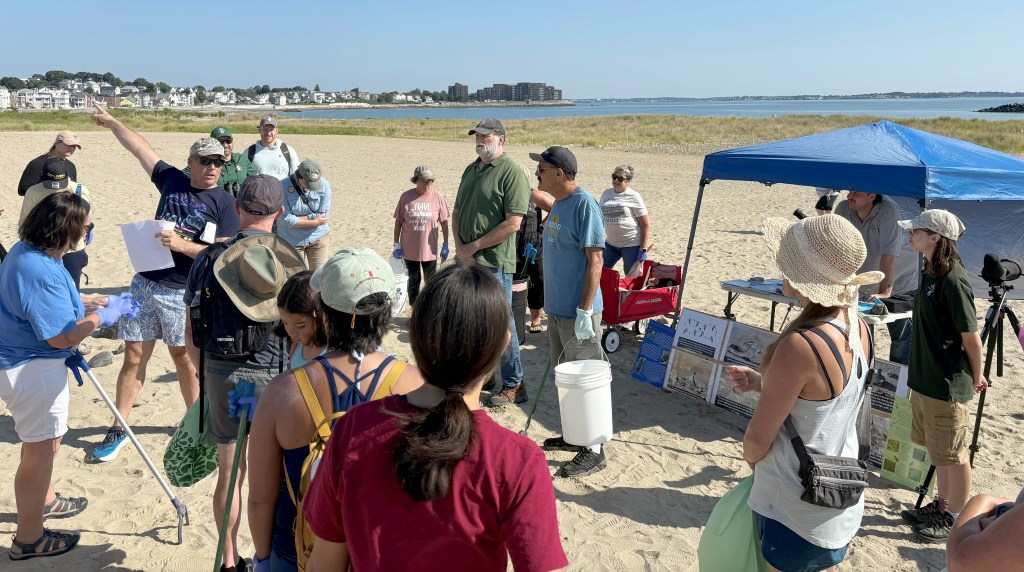
The effort was organized by local and state officials, representing the Massachusetts Department of Conservation and Recreation, who brought gloves, bags and other supplies. But the DCR officials also brought warnings, telling participants that state environmental protection rules don’t allow any large-scale removal of the seaweed.
The result was that while the nearly-mile-long central beach in Winthrop was thoroughly combed for trash – a problem described by town officials as worsening this year – the seaweed was left mostly untouched.
Much of that outcome was foreshadowed a few weeks earlier at a meeting of the Winthrop Town Council, where the same DCR officials made clear that the seaweed has significant environmental benefits and enjoys legal protections, and town health officials agreed that the bugs it attracts pose no significant threat to people.
Among other things, seaweed left on a beach helps protect against erosion, and provides important food and habitat for marine life, the state officials said. The seaweed is “extremely valuable ecologically,” Eric Seaborn, a director of natural resources at the state conservation agency, told the Town Council.
It is true, Meredith Hurley, Winthrop’s public health director, told the council, that while the sand flies arising from the seaweed can produce allergic reactions in some people, the bugs pose little to no disease risk.
The seaweed nevertheless has stiffened complaints from a number of residents already bothered by protections on the beach for the piping plover and other shorebirds. State law requires roped-off barriers on limited sections of many beaches, including Winthrop Beach, to allow piping plovers – listed as threatened at both the state and federal level – the necessary time and space to raise their young. A species known as the “least tern” is also present on Winthrop Beach and is also considered threatened.
And even outside those roped-off areas, state conservation officials told the Town Council, activities such as raking the beach are legally limited to avoid harming the shorebirds.
Winthrop Beach a leader on protections
Those efforts have been productive, state officials said. At the weekend cleanup event, the state conservation officials said that with the protective fences now coming down, Winthrop Beach has produced better-than-average numbers of piping plovers, and that Massachusetts overall is first in the nation.
Still, some in town question the purpose of such careful environmental stewardship. One member of the Town Council, Suzanne Swope, said the seaweed nurtures the flies and other bugs, traps trash, and gives off unpleasant smells.
Another Town Council member, Rob DeMarco, asked the state officials to explain how they determine the details of the shorebird protections, adding: “They’re not indigenous to Winthrop.”
The piping plover and the least tern are, however, migratory birds that are considered native to North America, and they have been tracked by naturalists along the Atlantic coast since at least the 1800s. They also are considered valuable to healthy ecosystems because they help keep in balance populations of both their predators and prey.
The details of the fencing and its duration are determined through a complex set of standards and ongoing assessments developed from experience in protecting the shorebirds, the state officials said.
As the volunteers at Winthrop Beach headed out for the weekend trash collection work, they were reminded by state conservation officials that they only could remove seaweed that was unavoidably entangled with trash. And under no circumstances, they were told, could they take away more a third of all the seaweed on the beach. They came nowhere close to that – the rule about trash entanglement meant that only minor amounts of seaweed ended up being removed.
Both state and town officials agreed that rules for beach conservation should be designed with consideration of humans and the birds, and that they would keep working together to address resident concerns as much as possible within limits necessary to protect the overall health of the marine environment.
Insufficient attention to environmental balance regularly costs people in Winthrop and many other locations their access to entire beaches. Two Winthrop beaches – Halford and Donovan’s – were among 62 closed statewide over this past weekend because they exceeded safe bacteria levels.
While that problem is caused in many other locations by municipal plumbing systems that combine wastewater and stormwater in the same pipes, contributors in locations such as Winthrop could include homeowners using too much fertilizer in their yards, and wildlife and pet waste, officials said.
 Winthrop Pilot
Your input is welcome. We encourage respectful and constructive dialogue. Comments that contain hate speech, personal attacks, spam, or other inappropriate content will be removed. Repeat violations may result in a temporary or permanent ban from commenting.