
Winthrop’s Board of Registrars of Voters tried to give new life to the recall petition against Town Council member Max Tassinari, saying the ouster question should reach town voters despite falling short of the necessary number of signatures, before getting quickly contradicted by state officials.
The board voted 3-1 on Wednesday to side with recall proponents – who had long agreed with town officials that they needed 2,863 petition signatures against Mr Tassinari to put the recall question on the town’s November ballot, only to cite a much smaller threshold number immediately after they failed by a wide margin to achieve that original target.
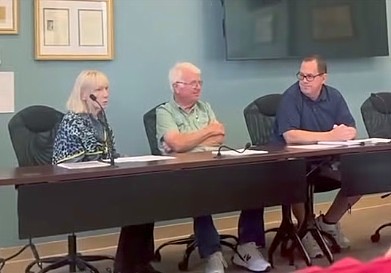
But in doing so, the Board of Registrars further widened the town’s ongoing political drama. The board consists of three appointed members and the town clerk, Denise Quist. And in a possible conflict of interest, all three of those appointed members appear to have signed the petition that sought Mr Tassinari’s recall. The three also appear to have met privately before their public hearing to reach a unified position against Mr Tassinari, in potential violation of public meeting laws.
In response to a query from Ms Quist immediately after the registrars’ vote, a top state elections official said that Winthrop town officials should stick to their original assessment that the recall proponents did not meet the signature threshold, and affirm that the town’s Board of Registrars of Voters has no voice in the matter.
“It seems to me that the Board of Registrars did not and do not have the legal authority to interpret the charter or to overturn the determination that the question didn’t qualify,” Michelle Tassinari, director of the Elections Division of the Office of the Secretary of the Commonwealth, wrote to Ms Quist. Ms Tassinari is not related to Max Tassinari, who is also a state employee.
State Chides Town
Ms Tassinari noted in her response to Ms Quist that state elections officials had previously told Winthrop town officials – including the Board of Registrars itself – that the Board of Registrars is not the proper entity for such matters. Ms Tassinari told Ms Quist: “Please have your town counsel contact me as soon as possible.”
The showdown is the latest chapter of a long-running saga involving a small group of activists working with out-of-town allies who oppose the 2021 state law known as 3A, that generally requires cities and towns to create or expand districts where multifamily home construction is allowed. Winthrop is among a dwindling number of communities still challenging the state’s right to set zoning rules, even though courts have ruled in the state’s favor and Winthrop is now facing losses in state funding eligibility.
Mr Tassinari is the latest among several members of the Winthrop Town Council to face recall efforts, so far unsuccessfully, over the issue. He was elected to a four-year at-large seat on the Town Council in November 2023, by a nearly 2-1 margin among voters town-wide.
The campaign against Mr Tassinari amassed 1,992 confirmed signatures from town voters – or about 30 percent short of the established goal. But recall campaign leaders then argued that their petition needed only 822 signatures, or 20 percent of voters in the town’s most recent election, rather than the 2,863 signatures, or 20 percent of all registered voters – the level that they and town officials had both announced publicly as the target.
The registrars held a 25-minute hearing on Wednesday morning at which they listened to brief arguments from the recall proponents, and from Winthrop’s town attorney, Jim Cipoletta, who backed Ms Quist in calling the 2,863 figure the correct requirement.
Registrars face probe
The registrars were led by Paul Reardon, an appointee named to the board last summer by the Town Council, who said after the competing presentations that he found the town government’s official language on the signature requirement to be “clearly ambiguous.” He then announced that the three appointed registrars had already decided, without debating it in public, that they had collectively and unanimously agreed that the town should allow the question of Mr Tassinari’s removal to be included on the November election ballot.
That conclusion, Mr Reardon said, reflected a desire to “Err on the side of voters.”
“My point is that it’s not clear, and as a board, we feel that people should not be penalized for poor writing,” he said.
That left both town officials and outside backers of Mr Tassinari promising to pursue legal and political options. Allies of Mr Tassinari said they already have made a filing with the State Ethics Commission over the evidence indicating that all three of the appointed registrars signed the recall petition they were ruling upon, and that they met on the matter outside of their public forum.
Mr Reardon also signed up months ago to become a candidate for Town Council himself in this year’s elections.
Mr Reardon wrote his own email to the state elections division on August 22, asking for its guidance on how the town Board of Registrars should handle the argument by recall proponents that they met the necessary signature requirement. Mr Reardon, without describing himself as a backer of the recall movement, said in his note to state officials that the recall campaign “would like us to make a ruling on it.” Ms Tassinari wrote back that same day, telling Mr Reardon that his body was not the place for such assessments. “It is unclear under what state law, regulation or other authority the Board of Registrars would have the ability to make such determination as to how the required number is calculated,” she told him.
Must Defend It
Yet Mr Cipoletta, while also predicting court action on the matter, may have limited the town’s options by assuring the registrars at the start of their meeting that he would have to take their side going forward. “As the town attorney, whatever you decide, if it’s challenged, I have to defend it,” Mr Cipoletta said, in pleading with the registrars to consider the question in front of them “in a very thoughtful deliberative logical way.”
Mr Cipoletta acknowledged in the registrars’ hearing that the language in the town charter on signature levels does alternate between using the terms “voters” and “registered voters,” but he said that it makes clear in its section on definitions that the wording means all “registered voters” in the town.
He also noted that Ms Quist, at the start of the recall team’s signature-collection effort, wrote on their paperwork their need for 2,863 signatures. The recall campaigners also cited that figure repeatedly and publicly during their signature-collection efforts as their own understanding of the requirement.
The recall proponents were led at the hearing by Michael Walsh, a lawyer who has been guiding efforts around the Boston area to convince towns to defy the state over the 3A housing law, and Diana Viens, an attorney and daughter of a current Winthrop Town Council member, Suzanne Swope.
Among their arguments to the Board of Registrars, Mr Walsh suggested a fundamental constitutional unfairness in setting a signature collection requirement for recall efforts so high that it would be effectively unattainable.
Yet the general requirement for recall petitions at the state level in Massachusetts is even higher, at 25 percent, as part of what governance experts have described as a need to deter frivolous attempts to remove elected officials. And Mr Cipoletta, while participating in the hearing, told the registrars that he understood that any assessment of proper signature levels is a constitutional question that should be decided by courts rather than by municipal boards.
Mr Tassinari offered no comment on the matter.
The Massachusetts attorney general, Andrea Campbell, meanwhile Wednesday gave approval to 44 prospective questions for the statewide ballot next year, including initiatives to repeal the 3A housing law and more broadly reduce state power over zoning. Proponents of the questions next need to collect signatures from 74,574 registered voters statewide by December 3, to advance their proposal to the stage of legislative approval.
 Winthrop Pilot
Your input is welcome. We encourage respectful and constructive dialogue. Comments that contain hate speech, personal attacks, spam, or other inappropriate content will be removed. Repeat violations may result in a temporary or permanent ban from commenting.