
As the Northeast Metropolitan Regional Vocational Technical School nears the opening of its new $317 million home, amid a jump in demand for career-focused training, Winthrop remains one of its most disinterested member communities, with distance and traffic seen as a major hurdle.
Northeast Metro Tech has only 61 enrollees from Winthrop among its 1,415 students from 12 North Shore communities. That’s multiples of Winthrop’s historic numbers at the 57-year-old vocational high school, but still well below the per-resident average of most other towns.
Overall, interest in career and technical education at the high school level is surging both statewide and nationally, balancing out the more standard emphasis on academic preparation leading to college enrollment. And the Voke is expecting heavy interest in its new 1,600-student facility along the western boundary of the Breakheart Reservation. One key part of the new facility is an expanded non-traditional schedule – including a mixed format schedule where students can take academic classes in their hometown school in the mornings and vocational courses at Northeast in afternoons.
“We’re trying to be creative about that,” the Northeast Metro Tech superintendent, David DiBarri, told the Winthrop Town Council at a hearing last month.
Transportation challenge
Northeast Metro Tech offers programs in areas that include automotive technology; carpentry; cosmetology; culinary arts; drafting and design; electrical; HVAC; plumbing and pipefitting; and robotics and automation. As is common at community colleges, Voke staff meet with local employers to gauge and respond to industry demand, and help guide faculty.
More than 80,000 Massachusetts high school students – more than a quarter of the statewide total – were enrolled this past academic year in a vocational-focused program, up 17 percent in two years, according to state officials. And the Massachusetts Association of Vocational Administrators has estimated that another 6,000 to 11,000 students would like to be in such programs if there was space for them. The Healey administration has set a goal of adding 3,000 such spaces in the next three years.
Yet Winthrop has only about 10 percent of its high school students at the Northeast Metro Tech campus in Wakefield, their main option for such programs. Cultural norms and expectations may be part of the explanation, said Rob O’Dwyer, Winthrop’s representative on the Voke’s board. Though the travel time from Winthrop to the Wakefield campus – often as much as 45 minutes each way – is probably the most substantial barrier for students who might otherwise choose to enroll, he said.
“The distance is a big one,” Mr O’Dwyer said after the Town Council briefing, explaining Winthrop’s relatively small presence at the Voke as a share of its population. “Out of all the towns that send to Wakefield, we’re likely the one that’s farthest away,” he said.
Mr O’Dwyer, the director of admissions and enrollment at an adult-focused trade school in Boston, has even felt that dilemma within his own family. One of his children, pushing back at the idea of attending the Voke in Wakefield, explained to his father: “Why do I want to commute so far and leave all my friends?”
Town programs
Beyond the Voke creating its new split-day format, solutions to the transportation headache could include adding vocational courses at local high schools, Mr O’Dwyer said. Revere – a city with three times the population of Winthrop and an annual waitlist of 200 students at the Northeast Metro Tech campus – has in recent years hosted a satellite program in plumbing with visiting instructors from the Voke.
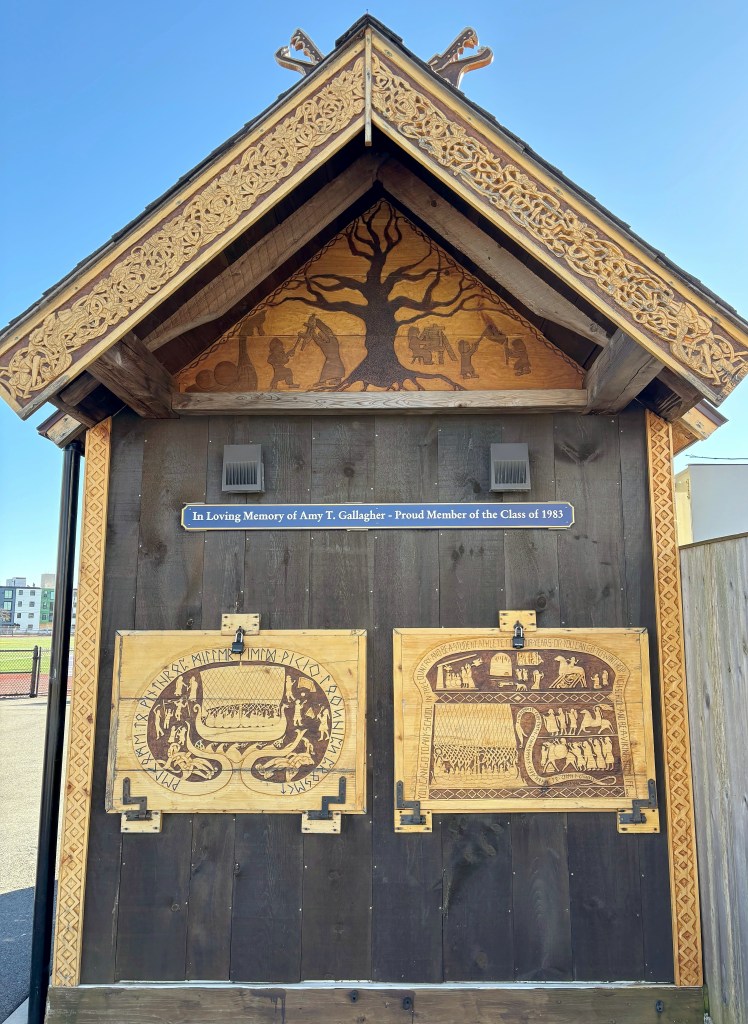
That program was challenging to run and recently was discontinued. But such a model might be one type of future option to consider for students in Winthrop, Mr O’Dwyer said. Winthrop High School has had its own long-running in-house vocational-style course option, covering skills that include woodworking and metalworking, known as the Viking Longship program.
But expanding that kind of approach looks like a tough task in Massachusetts – even with vocational training enjoying a rebound in respect, Mr O’Dwyer said. The state’s network of regional vocational schools may not be great for student access, he noted, but it does offer important operational efficiencies. Substantially reviving a town-specific model therefore just doesn’t seem likely at the moment, Mr O’Dwyer said. “That ship has kind of sailed,” he said.
The main act of boundary-breaking these days instead appears to be in the direction of vocational school students wanting a greater educational mix. Northeast has an option for students to take some college courses while earning their high school diploma, and Mr O’Dwyer noted that its collegiate studies program was recently credited with having the highest participation rate among all vocational schools in Massachusetts.
Educational balance
And when construction materials costs spiked upward during the Covid pandemic, and the Voke faced pressure to cut costs for the new building, Mr O’Dwyer successfully defended the retention of its planned performing theater, citing advantages in such areas as teaching social and emotional behavior, and skills important to customer and business relations.
The result means that many Northeast Metro Tech graduates are capable of pursuing advanced education, even if they still see value in their original career-oriented objective. At one recent graduation ceremony, Mr O’Dwyer said, the valedictorian received five college scholarships totaling $20,000, but turned them down because he already had been offered a good-paying job in the HVAC industry.
From a budget perspective, Winthrop might also conclude that it has little reason to agitate for any major course correction. Northeast Metro Tech spends slightly more than $27,000 per student, while Winthrop High School spends just under $18,000, according to 2023 state figures, translating into Winthrop taxpayers incurring added costs for each town student who attends the Voke.
For years, Winthrop supplied the Voke with far below its population-based student allocation. At 61 students, Winthrop is now meeting its share, and has given indications of being generally satisfied with that level. “We are taking advantage of, or maximizing, the number of slots that are allowable to us,” Mr O’Dwyer said.
 Winthrop Pilot
Your input is welcome. We encourage respectful and constructive dialogue. Comments that contain hate speech, personal attacks, spam, or other inappropriate content will be removed. Repeat violations may result in a temporary or permanent ban from commenting.