
Massachusetts should consider a more aggressive approach to nuclear power plant construction, perhaps even including one on Deer Island if the technology and location meets scientific muster, state Representative Jeffrey Turco has suggested.
The general idea of expanding nuclear power in Massachusetts is being pushed by Governor Maura Healey, who asked the state legislature last spring to repeal a 1982 state law that requires statewide ballot approval for any new nuclear power plants.
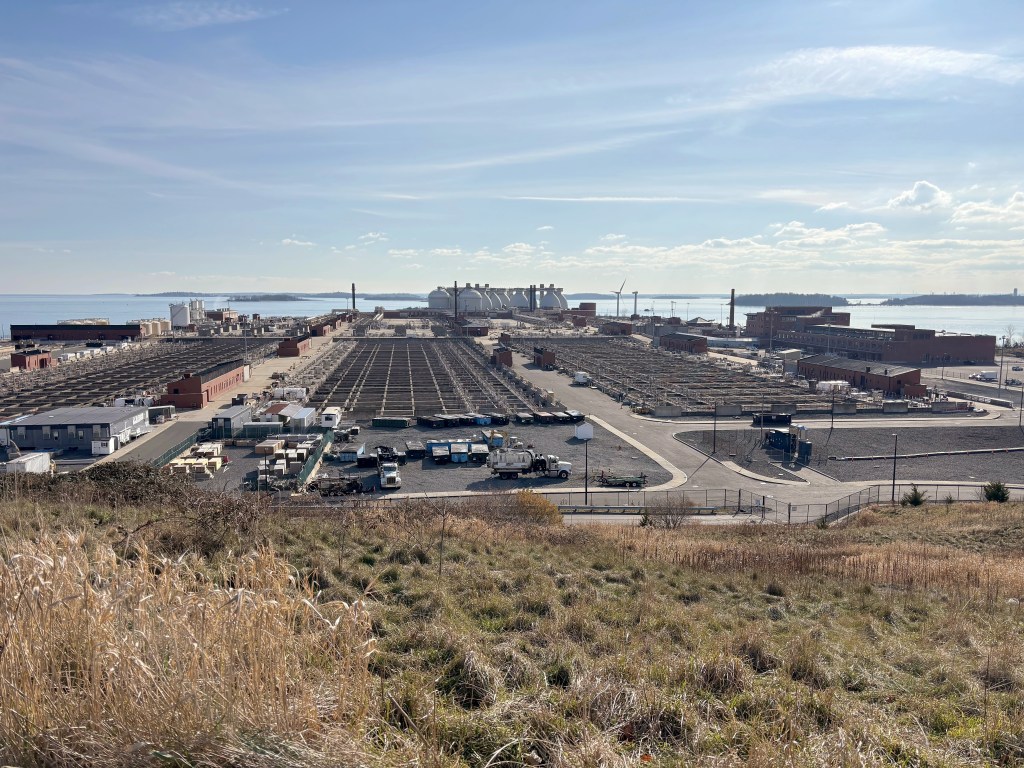
Representative Turco, in an appearance on WCAT’s Winthrop and the World program, said he backs the governor’s initiative, largely as a hedge against rising electricity prices – even to the point of potentially seeing one built next to Winthrop.
Freaked out
“It naturally gets people freaked out,” Winthrop’s state representative acknowledged, recalling the emotional battles in the 1970s and 1980s over the construction of the Seabrook Station Nuclear Power Plant in New Hampshire.
Yet Seabrook and the overall industry has since proven itself to have a safe track record, Representative Turco said. And analysts have suggested that smaller reactors would allow for a rapid spread of flexible low-cost plants in a variety of locations.
Asked if his enthusiasm could potentially extend as far as a considering a nearby place like Deer Island, Representative Turco said he would be willing to let the Massachusetts Water Resources Authority – the operator of the sewer treatment plant at Deer Island and two wind turbines on the property – assess that kind of initiative.
“If the MWRA came to Boston and came to Winthrop and came to Revere – the neighboring communities – and said, ‘Here’s our proposal,’ and it was backed by science, of course I would support it. There’s no problem,” Representative Turco said on the broadcast.
Public support
The hurdles, however, could be significant, even under a friendly governmental approach to nuclear power. A site like Deer Island, while perhaps not totally out of the question pending a formal analysis, looks quite challenging due to its location near Logan airport and downtown Boston, said Kathryn Huff, an associate professor of nuclear, plasma and radiological engineering at the University of Illinois at Urbana-Champaign.
“It would not be my ideal location,” said Professor Huff, a former US assistant secretary for nuclear energy and outspoken advocate for a resurgence of commercial nuclear power. But the willingness of a local politician to publicly support such a possibility is nevertheless an indication of the general nationwide rise in sentiment favoring commercial nuclear power, Professor Huff said. Polling last year by the Pew Research Center showed 59 percent of Americans supporting nuclear power plants, in a steady rise from 43 percent in 2016.
On the WCAT program, Representative Turco raised the issue of commercial nuclear power in the context of his wider concern over fast-rising electricity prices in Massachusetts and his belief that the state should respond with steps that include reducing its commitment to lowering carbon emissions.
He has put particular focus on repealing a 2021 state law known as Net Zero that adds surcharges to energy bills to fund a program, Mass Save, that helps home owners with the cost of energy efficiency projects such as weatherization and the installation of heat pumps. Mass Save was intended to disproportionately help lower-income residents, though a state audit found it often subsidizing work for wealthier homeowners.
And yet, according to a recent study by the environmentally focused research and advocacy group Acadia Center, energy efficiency programs across New England, including Mass Save, overall have saved households and businesses in the region $2.93 for every dollar invested. Such programs benefit all ratepayers by lowering demand, especially during peak times, the Acadia Center said. The more significant factor in rising utility bills, both electric and gas, the group said, is the high cost of maintaining natural gas distribution networks– a major existing problem in Winthrop.
Turbines challenged
Representative Turco said he was further alarmed by Trump administration efforts to fight offshore wind turbine projects including several being built south of Martha’s Vineyard that state officials have held out as key to reducing consumer energy costs over the long term. The coastal turbines so far have reached the size of only about 1 percent of statewide electricity production, and their backers are having some initial courtroom success in fighting federal efforts to block new turbine construction. Yet Representative Turco said that the bottom-line result is that any significant expansion of wind projects doesn’t appear viable for the last three years of the Trump administration, and that Massachusetts should stop counting on future cost savings from them.
“Those things are essentially gone,” he said of various proposals to expand offshore wind generation. “So now that we know that’s going to happen, we have to say, how do we adjust to accept the new reality?”
Nuclear power, by comparison, has Trump administration backing and is attracting the attention of major technology companies – including Amazon and Google – that are trying to meet the extremely high energy demands of the computer data centers they are creating for running artificial intelligence systems. The biggest such data-center project in Massachusetts appears to be a $4 billion facility planned for Westfield that, if built, would consume 10 times more power than the largest existing facility, in Boston.
That scale of power demand is raising concern among policymakers at all levels – including Representative Turco – who warn they can drive steep hikes in consumer energy costs, since the expansions in electricity supply necessary for AI centers are often shared among all consumers. Yet the issue of AI data centers could mean a gain for nuclear power overall, he said.
Safer option
The Trump administration may, in fact, be too friendly toward nuclear power, Professor Huff said. Nuclear power is currently one of the safest ways to produce power, scoring better even than solar or wind, and far superior to fossil-fuel sources, as measured by deaths per terawatt-hour of electricity generated, she said. But the Trump administration has been waging a broad battle against federal regulatory oversight that could make nuclear power grow more risky in the future, she said.
Representative Turco said that while he accepts that fossil-fuel reliance poses its own major risks and costs, he’s taking his position against Mass Save because China and Africa are responsible for “the largest expansion of carbon emissions in the world.”
“Look up how many new coal plants China is building every year,” he said. China is adding electric-powered cars, he acknowledged, but “they’re powering the EVs with coal plants,” he said. The US can’t stop rising carbon emissions on its own, and Massachusetts shouldn’t expect Massachusetts taxpayers to fix that, he said.
“If Massachusetts shut down every factory, shut off every piece of electric electrical equipment today, it would have zero effect on overall climate issues,” Representative Turco said. “It’s not something we’re going to solve here in the Commonwealth – it’s a worldwide problem.”
Loud complaints
China has been building new coal plants. But China’s power generation from coal fell by 1.6 percent last year as it made record gains in solar and wind power, UK-based Carbon Brief reported earlier this month. Greenhouse gas emissions in the US, meanwhile, increased by about 2.4 percent last year, as the Trump administration has pushed a revival of coal power, the research firm Rhodium Group reported this month.
A key point, however, is that people in Winthrop are upset by their electricity bills, Representative Turco said. “Energy affordability should be the top priority,” he said, “because the people that I talk to on a given day in this town, that reach out to me and complain about the cost of living in the Commonwealth – they’re talking about the cost of utilities, they’re talking about the overall cost of housing, the cost of living in the Commonwealth.”
As for nuclear power, the Healey administration is awaiting from experts at the University of Massachusetts at Lowell the results of a study of the technology’s prospects in the state, with an expectation of both moving quickly to identify construction sites and recognizing the likelihood of some local opposition.
The Healey administration also touted the completion this past week of a 145-mile high-voltage transmission line called New England Clean Energy Connect that is carrying to Massachusetts power generated by hydroelectric facilities in Quebec. The line can deliver about 20 percent of total electricity needs of Massachusetts and save ratepayers $50 million a year over its 20-year fixed price contract, administration officials said. But some experts have questioned the projections and noted the savings amount to only about $20 per Massachusetts household.
 Winthrop Pilot
Your input is welcome. We encourage respectful and constructive dialogue. Comments that contain hate speech, personal attacks, spam, or other inappropriate content will be removed. Repeat violations may result in a temporary or permanent ban from commenting.