
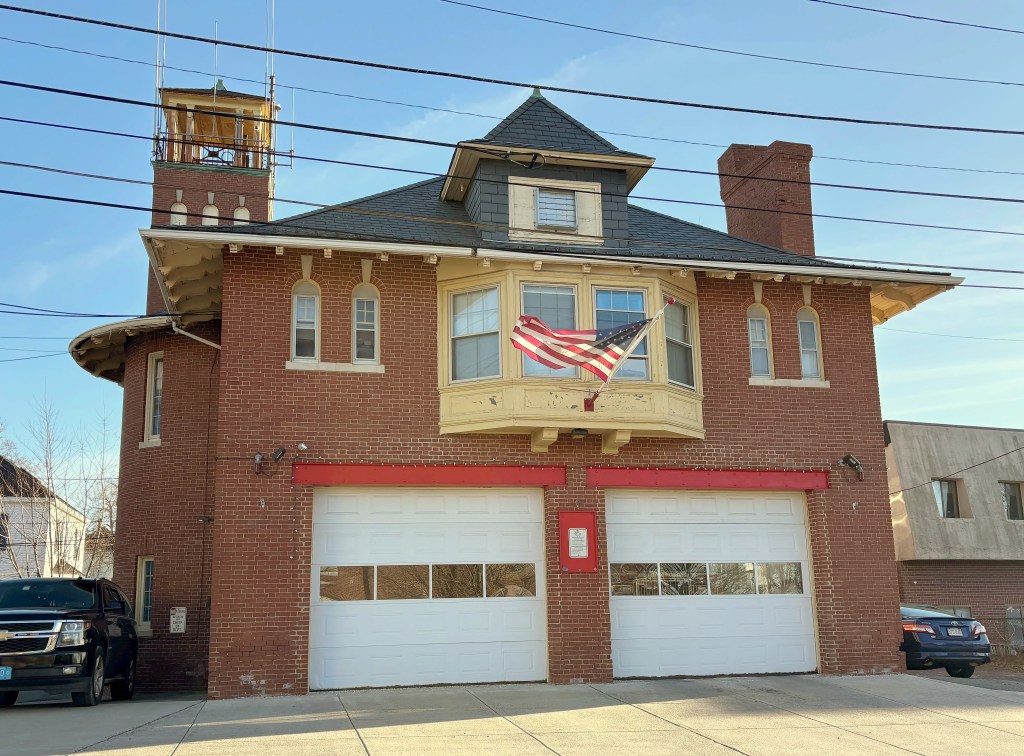
Winthrop-area arts and education advocates are taking cheer from a preliminary proposal to create a new performing arts center in the town’s soon-to-be-vacated downtown fire station.
The idea has been percolating for months in Winthrop, especially after town residents voted last April to spend $38.5 million for a new Fire Department headquarters to replace the town’s two century-old stations.
Among other implications, the initiative could mean that Winthrop – a town with little commercial industry and limited after-school options – could both revive its decades-old theater tradition and greatly expand musical and stage training for its students.
Council proposal
The possibilities are exciting, said Solstice Lauren, the producer of a play that was staged last summer at the Point Shirley Association Hall, who envisions bringing three or four shows a year to Winthrop if the space can be found.
“That’s what theater is all about: converting things into new things,” Ms Lauren said of the fire station reconstruction idea.
The prospect got a boost when the Town Council president, Jim Letterie, in his inaugural speech to the newly elected council this month, briefly described the possibility that “a community center for performing arts and events” could be built with some amount of taxpayer assistance in the nearly 150-year-old main fire station building on Pauline Street.
“With subsidized rates for nonprofits,” Mr Letterie said, “this center would become a vibrant hub for culture, creativity, and connection, bringing our community together in ways that inspire, entertain, and enrich us all.”
Community suggestions
Mr Letterie has not responded to requests for details. Ms Lauren, though, said that she and members of her theater group, Sereluna Productions, are among multiple people who have suggested such ideas to Town Council members, in their case emphasizing the theater component.
Other advocates include Marci Hamilton, a local activist and child care provider, who has suggested the model of Zumix, a private nonprofit operation in East Boston. Zumix also uses a former fire station, with an emphasis on teaching students about music and creative technologies – and filling a range of gaps in human development and personal guidance left by the public school system.
A Zumix co-founder, Madeleine Steczynski, said she and a small group of volunteers managed to create their organization back in 1991 without any government support, and said she’s greatly encouraged by the idea that Winthrop’s Town Council might consider some level of public investment in its fire station redevelopment.
Ms Steczynski shared Ms Lauren’s expectation of potentially wide benefits for the Winthrop community. But it also won’t be easy – with or without a government partnership – and will require careful consideration of what exactly the project aims to accomplish at what cost, Ms Steczynski said.
Existing strengths
Winthrop does come to the moment with existing strengths, including a high school drama program led and nurtured through the decades-long tenures of Karen Calinda and the late Neil Shapiro. It also has the emotional and possible financial remnants of the Winthrop Playmakers, a community theater with origins dating to 1938 that finally closed its doors in 2014.
A longtime leader of the Playmakers, Pam Racicot, in an appearance last year on WCAT’s Winthrop and the World program, recalled decades of struggles to keep it afloat. The Playmakers used various rental spaces, before buying the former First Baptist Church on Hermon Street as its home in the 1970s.
“We all worked our butts off,” running bake sales and other fundraisers, to keep the building open and the theater running, even as unmet utility costs sometimes left actors and audience members either sweltering or freezing, Ms Racicot said. “We tried to have as much fun as we could, but also make it work,” she said.
Ms Steczynski said she well understands that kind of labor, and the deep meaning behind it. She was a relatively carefree young professional, who just moved to East Boston in the late 1980s, when the city became convulsed in gang violence. One day, she came to listen to Ted Landsmark – the survivor of the infamous flagpole attack on City Hall Plaza in April 1976 – at a community meeting organized by Mayor Ray Flynn. There she spoke with Mr Landsmark, hired by the mayor to boost youth and workforce development, and came away determined to help young East Bostonians find togetherness in music rather than gangs.
Rewards and tradeoffs
She and other Zumix founders first worked out of their homes, then rented spaces, before buying from the city in 2008 the long-abandoned fire station where it is now located. There, Zumix – with an annual budget of about $3 million, mostly from donations – serves hundreds of students, mostly from low-income backgrounds. The curriculum officially centers on music, technology and creative skills, but unavoidably touches on all aspects of student life and development, to the point where Ms Steczynski often finds herself enmeshed in personal side projects like trying to find housing for her students and their families.
Its public honors include the National Arts and Humanities Youth Program Award, given at the White House in 2012. Its human achievements, Ms Steczynski said, include the student who started in a song-writing class at age 12, progressed through a series programs at Zumix to understand her interests, and is now pursuing a doctorate in mathematics after getting a full scholarship to Northeastern University.
The effort is a constant tradeoff of money and effort for community benefit, Ms Steczynski said. Zumix rents its building for events such as quinceañeras, the traditional Latin American celebration for a girl turning 15. After all the staff time spent coordinating plans and permits with hosts and caterers for such an event, the five-hour rental fee is probably a net loss for Zumix’s budget, Ms Steczynski said. “And yet, you’ve given somebody support to have a really important meaningful landmark event in their life, and invite all their family and friends, and have a communal space to do that,” she said.
Ms Lauren also sees the potential for deep community transformation. A native of Gloucester and theater student at Vassar College in New York, she worked with her partner, Ian Page of Winthrop, to stage three showings of their play, Worm Food, this past August on Point Shirley. And they hope to make a regular habit of theater productions in Winthrop once she graduates from Vassar and moves to the area.
Really sacred
“Boston has so many for-profit theaters and nonprofit theaters, and professional, and they’re all great,” Ms Lauren said. Yet, she noted, “they’re not always quite as accessible to people in the outskirts of Boston, who want to see people that they know, or want to get involved themselves, so we want this to be something that everybody can access as much as possible.”
For their budding theater ambitions, Ms Lauren said, she and Mr Page made with thoughtful intent their decision to try staying in Winthrop.
“This town is really small, and I love it so much – I love spending time here, I could see myself remaining here for a very long time, even though I didn’t grow up there,” Ms Lauren said. “But I think with such a small town comes, sometimes, a hesitance to create any kind of change, because people have grown up a certain way and really love it. And I think that’s really sacred.”
And the specific possibility of doing that in the fire station occurred to her and friends one day while traveling past the building.
Romance and caution
“I think Winthrop, being such a small community that has its own traditions and heart, really could benefit from a place where people have conversations about empathy, about people whose lives are different than ours, and that’s what theater is for, in my opinion,” she said. “I think it would be a great way to keep the town moving forward in a way that doesn’t kill its history.”
In her WCAT appearance, Ms Racicot noted that the Playmakers closed its doors with some revenue in its bank account that it would be willing to use to assist a future attempt at reviving theater in town. Yet, she noted in response to the Town Council speech, “We have heard this kind of thing before and always hope to see follow-through.”
Similarly, Ms Steczynski said she is very willing to share Zumix’s hard-earned expertise – “but only if there some real interest by people.” A parallel effort has been struggling to make headway in Revere, she noted, also involving an abandoned fire station. And in the Jamaica Plain section of Boston, activists created a popular community arts center in an old fire station, only to give it up when building maintenance costs overwhelmed them. It’s now an ice cream store.
Such talk now in Winthrop is exciting, and should also be sobering, Ms Steczynski said. “There is a romance to taking a fire station and making it into something,” Ms Steczynski said. “If a town like Winthrop wanted to pony up $1 million a year,” after handling start-up costs, with the idea of getting matching outside funds, she said, “you could begin a conversation with an organization like us.”
 Winthrop Pilot
Your input is welcome. We encourage respectful and constructive dialogue. Comments that contain hate speech, personal attacks, spam, or other inappropriate content will be removed. Repeat violations may result in a temporary or permanent ban from commenting.