
Dozens of Winthrop teachers and their allies rallied inside and outside a town School Committee meeting this week to decry the lack of progress during the last nine months of contract negotiations.
Eight months after their last contract expired, the Winthrop Teachers Association and its supporters protested before the School Committee meeting on Monday, then several more came inside to deliver more detailed appeals.
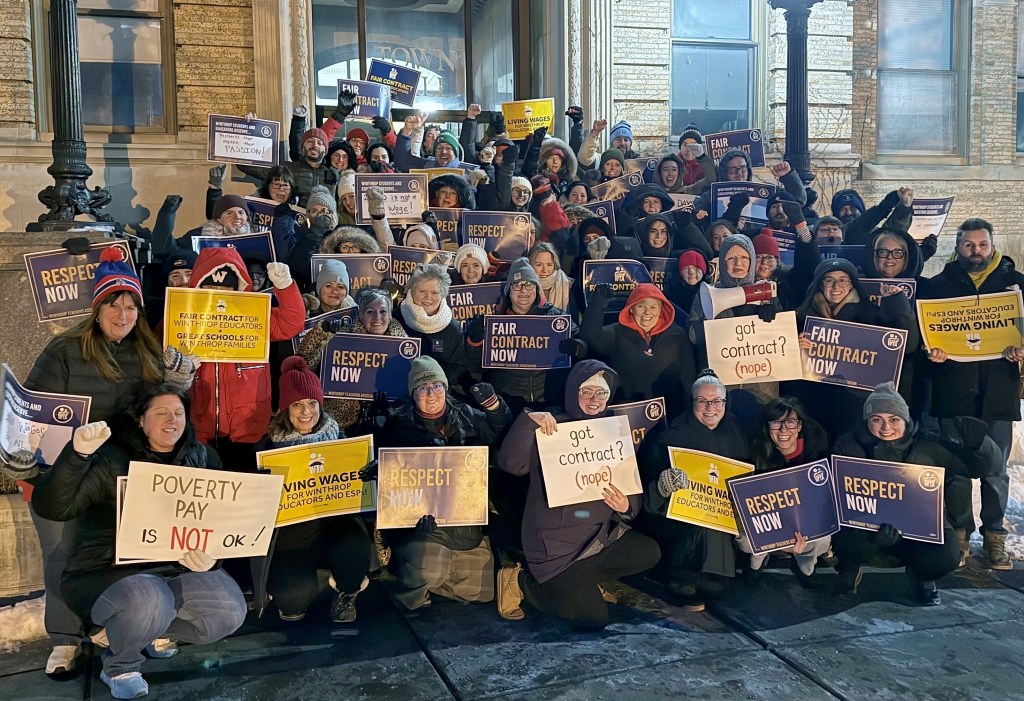
They included teachers struggling to survive on below-poverty wages, working multiple jobs to try and make ends meet. Educators who spoke also included teachers who moved elsewhere to find livable wages, and warned the town, in particular the children, would suffer from its unusually high rate of teacher turnover.
Teachers suffering
“It is disgraceful that Winthrop is one of the lowest, if not the lowest, paying districts in Massachusetts,” said Suzanne Ackerman, a Winthrop resident and parent who teaches in Belmont.
Elizabeth Tarantino, a Winthrop resident and high school teacher, said the most recent pay raise for her and her husband – also a Winthrop High School teacher – “doesn’t even cover one quarter of the tax increase” the town just passed. “To be at the bottom of the financial profile, compared to our neighboring districts with similar financial profiles, is kind of embarrassing,” she said.
Yet the teachers union leader, Brian Donnelly, a digital video teacher at Winthrop High School, said afterward that the union members understand the financial and political circumstances in Winthrop, have a generally favorable view of the School Committee and its members, and remain positive on the overall direction of the talks.
“I’m leading with optimism here,” Mr Donnelly said in an interview. “We continue to be very hopeful that this is going to happen, and we’re excited to work with the School Committee to make that happen,” he said.
Complicated message
The combined message of both anxiety and hope, Mr Donnelly said, reflects such complications as the tough financial circumstances facing Winthrop, public expectations created by last year’s vote to fund the school’s operating budget, and long-delayed needs to modernize the contract in such areas as parental leave.
Negotiators have not fully shared the financial elements of their latest contract proposals, but Winthrop teachers have received annual pay raises of 2 percent in both of their last two contracts, which is below the rate of inflation.
And a member of Winthrop’s Citizen’s Advisory Committee on Finance, Shannon Poulos, said in a social media post that the union has been seeking a 23 percent increase in pay for teachers over three years, and a 39 percent increase for the ESPs including special needs instructors, at a cost exceeding $4 million.
The pay gaps have been felt especially hard by teachers with greater seniority, and by staff on the lower end of the salary range, generally those helping special needs students, who are paid only $21,000 a year, union officials said.
The shortfalls – especially on the upper end of the pay scale, relative to other towns – appear to be a leading factor in Winthrop ranking high statewide in teacher turnover among public schools, Mr Donnelly said.
Teacher survey
“We are the only school district around that doesn’t offer basic, humane benefits like paid parental leave,” John Cross, a life skills leadership teacher at Winthrop High School who is also vice president of the union and public school parent, told the School Committee. “When teachers are constantly leaving, our students pay the price.”
In addition to salary increases, respondents to a membership survey stressed the importance of some long-overlooked improvements to their compensation packages, including paid parental leave, bereavement leave, and leave for religious holidays, which are standard in most other towns, Mr Donnelly said in an interview.
The most recent collective bargaining agreement covering teachers, nurses, secretaries and paraprofessionals in the 250-member Winthrop union expired last June.
Contract renewal talks only began a month previous in May. The delay was due in large part, Mr Donnelly said, to the fact that union members, and many School Committee members, spent so much time working on behalf of the town-wide vote last April. By voting in the affirmative, residents agreed to help the schools by going nearly $5 million beyond the increase in local taxes that otherwise would have been allowed under the state’s Proposition 2-1/2 law.
Surrounding communities
The contract situation received additional attention late last year when the president of the Winthrop Town Council, Jim Letterie, who also serves as a member of the School Committee, said that Winthrop teachers should not expect salaries comparable to those of surrounding communities because the town provides them a better and safer community.
“The bottom line is, you’re working here,” Mr Letterie said in an interview on the topic. “You’re working in a great school system – the parents are involved, the parents care, it’s a nice safe community, you’re not walking through a metal detector in the morning. There are a lot of pluses.”
Mr Letterie complained that The Pilot’s description of his interview did not reflect his intentions of the topic, though he has declined opportunities to address the matter.
Mr Donnelly said he would not comment on the question of whether Winthrop’s community value should factor into pay rates, but he did say the Town Council president has been supportive of key union efforts, especially the need to support more senior teachers. School Committee members, including Mr Letterie, declined to comment on the talks.
 Winthrop Pilot
Your input is welcome. We encourage respectful and constructive dialogue. Comments that contain hate speech, personal attacks, spam, or other inappropriate content will be removed. Repeat violations may result in a temporary or permanent ban from commenting.