
Winthrop allows exceptionally easy exemptions to zoning rules governing the expansion of residential unit capacity at private homes, and the vice president of the Town Council is making a renewed effort to end them.
The council vice president, Suzanne Swope, at a recent public question-and-answer session, described Winthrop as one of only 13 communities across Massachusetts that allow “use variance” claims as a means of interpreting zoning appeals requests.
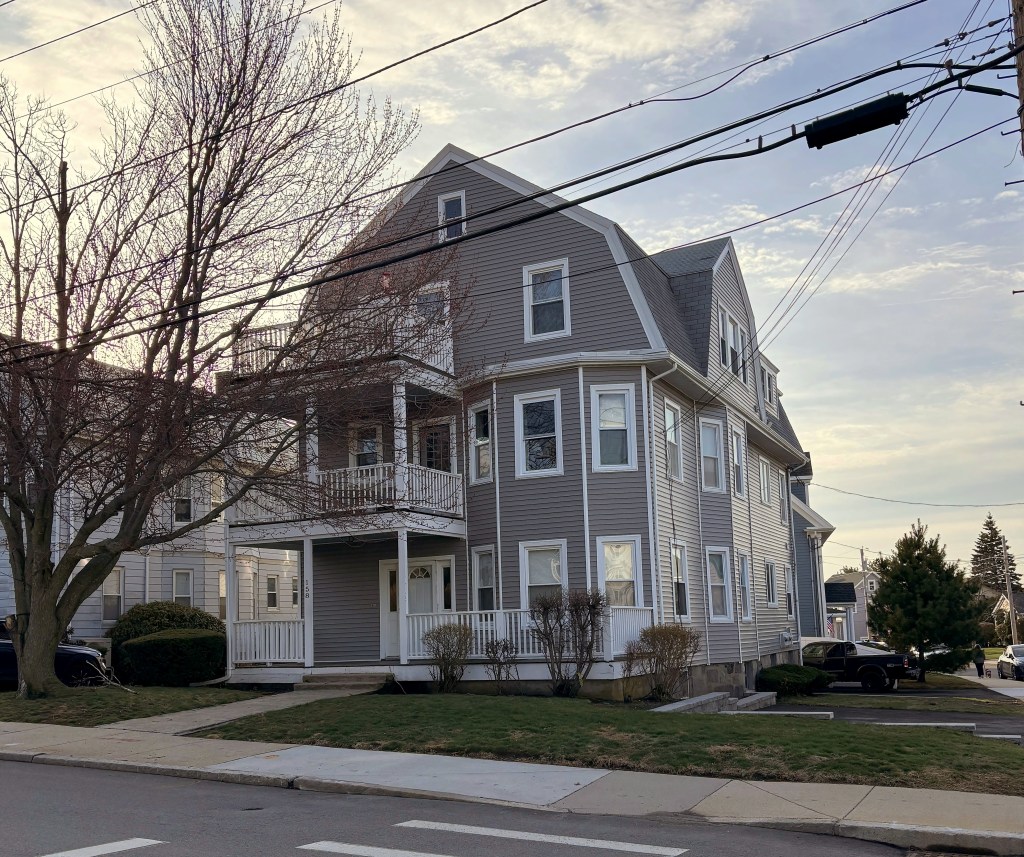
The generosity, Ms Swope said, includes instances such as the house at 158 Highland Avenue. It is located in an area of one-family and two-family homes, and yet managed to win variances allowing three and then four units, she said.
Ordinance sought
“That’s where I really got upset – this is not right,” Ms Swope said, recalling her initial awareness of that case.
Overall, she said, use variances are part of a situation in which Winthrop will have “easily 200” new housing units approved this year in a town of nearly 19,000 people.
In a bid to stop that, Ms Swope said, she will propose an ordinance for the Town Council to consider that would halt the use variance language. The town’s Ordinance Review Committee made a similar suggestion back in 2022, but the change was not approved by the Town Council.
Ms Swope was joined at her March 25 public discussion session at the Town Hall by another member of the Town Council, Kurt Millar, who largely endorsed her effort. “What’s the intent of having zoning if you’re just going to keep allowing these variances in all these areas,” Mr Millar said.
Winthrop rarity
The president of the Town Council, Jim Letterie, at his own question-and-answer session the following day, said he wasn’t familiar enough with the matter to take a position, but said he would “more than likely probably agree” with Ms Swope’s concern.
“I’ve seen a few over the years that I question,” Mr Letterie said, referring to variance approvals.
Winthrop is rare in allowing use variances in its zoning, said Josh Fiala, the head of the Land Use Department at the Metropolitan Area Planning Council, a state-created public agency that assists 101 cities and towns in Greater Boston on a range of municipal concerns.
Use variances are prohibited by default in every city and town in the state, unless a local zoning bylaw or ordinance expressly allows them, Mr Fiala said. And the “vast majority” of the 351 cities and towns in Massachusetts do not allow them, he said.
Housing anxiety
At the same time, Mr Fiala said, it is difficult to describe general practices or attitudes toward zoning in cities and towns across the state, given the widely varying conditions of individual properties, and the need to fairly handle the many “grandfathered” properties that complied with zoning laws when built but may no longer do so.
Winthrop’s zoning law talks of allowing rule variances concerning a proposed property use where “a literal enforcement of the provisions of this title would involve substantial hardship, financial or otherwise,” for the owner.
Ms Swope is raising the matter at a moment of high drama over housing policy. That anxiety is reflected in the fact that the Town Council has repeatedly refused to grant Winthrop’s compliance with the state’s 3A law, which generally requires more multifamily zones, even though the town can comply without adding housing in Winthrop. And the town’s voters in November elected a council with even more members backing that position.
Yet as Winthrop has grown more isolated on the 3A question, the repercussions are hitting harder. The town is among a handful of communities being sued by the state over their non-compliance, while losing an estimated $1.5 million in associated state grant money. Amid that, some of Winthrop’s Town Council members are showing signs of seeking some de-escalation of, and alternatives to, the 3A aspect of their bid to limit housing growth.
Federal possibility
At his question-and-answer session, Mr Letterie reiterated his intent to keep fighting the 3A law while acknowledging that state officials probably won’t change their position on the requirement – passed overwhelmingly by the state legislature in 2021 and repeatedly upheld by courts – at least during the administration of Governor Maura Healey, who is shown in polling as overwhelmingly likely to win re-election to a new four-year term in November.
The Town Council president then put new emphasis on a previously discussed approach – pursuing legal action in the federal court system. “Honestly our best chance of winning anything, in regard to 3A, is to get it to a federal level,” Mr Letterie said. “We don’t feel very confident” without that, he said.
Yet the Town Council president offered no timetable for a federal fight, and he held out the possibility that Winthrop could yet be helped on the state level, paradoxically, by the reality of the diminishing number of towns still fighting 3A compliance. “I look at it two ways,” he said. Persistently defying 3A could “look bad because they’re like, ‘Screw you, we’ll get you eventually,’” he said. “Or I look at it and say, ‘You know what, maybe they’re willing to bend a little just to make it look better to get it close to 100 percent.’”
Speaking of Ms Swope’s push for the Town Council to end use variances in Winthrop, Mr Letterie expressed his general support while discounting any urgency on that particular avenue. The council vice president’s estimate of 200 new housing units this year in Winthrop sounds large, and any flaw in Winthrop’s use variance language probably has had limited effect on that growth, Mr Letterie said. “I don’t think it’s the overwhelming reason that we’re getting a ton more units” of housing in town, he said.
Affordability issue
As for the housing issue more broadly, Mr Letterie said, the problem in Massachusetts centers on cost. “Can my son come back to Winthrop and buy a house? No, not right now. Maybe he will be able to, in a few years, or whatever – but we have an affordability issue,” he said. “I do not think we have a housing crisis.”
Mr Millar, backing Ms Swope’s desire to address the town’s variance rules, said that a homeowner’s eagerness to add residential units should not be considered a hardship for the property. He described zoning appeals hearings where property owners, asked to explain their variance request, “say, ‘More space,’ sometimes, to be able to build. And that is not a hardship.”
That kind of “loophole” is how the Seal Harbor Condominium complex was built, Mr Millar said, referring to the coastal complex where Ms Swope has her residence. “It really should not be allowed,” he said of such requests.
Ms Swope is the mother of a chief activist against 3A compliance. And as Town Council vice president, Ms Swope has attributed that opposition in part to her belief in the possibility – rejected by state officials – that 3A would alter Seal Harbor’s own governing rules in a way that would allow a greater number of residential units there.
 Winthrop Pilot
Your input is welcome. We encourage respectful and constructive dialogue. Comments that contain hate speech, personal attacks, spam, or other inappropriate content will be removed. Repeat violations may result in a temporary or permanent ban from commenting.