A decade after the opening of Winthrop’s Middle and High School building, the system’s budgetary dominance of extracurricular sports activity is far outpacing that of the arts, an imbalance that some parents and educators see as a loss for the community and its children.
Winthrop inaugurated its $80 million centerpiece school building project in September 2016 by touting highlights that included the 600-seat Neil Shapiro Center for the Performing Arts and its expected regular hosting of musical and drama performances.
The shows have gone on, to great student enthusiasm. At the same time, however, the Winthrop school system has reached a pattern of investing about 10 times as much money per year on salaries for coaching various school sports as it allocates to artistic and musical programs.
Spending variations
Winthrop’s spending on football coaches alone totaled some $33,000 in the 2024-25 season, some 40 percent higher than the entire $23,000 it spent on its various in-school arts and music positions. Total sports salaries exceeded $208,000.
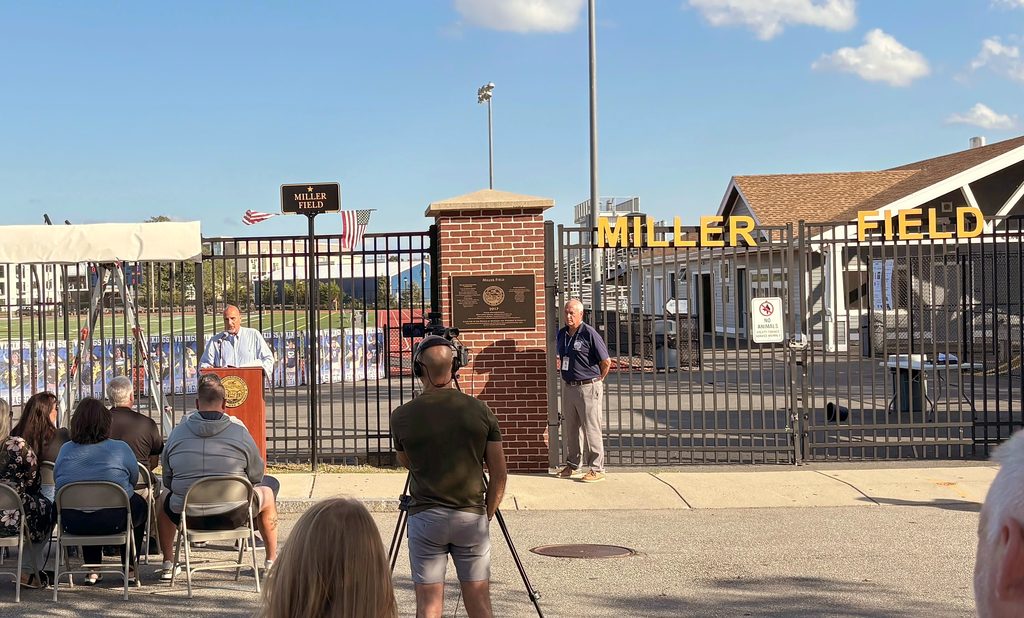
Major examples cited by parents include the loss of the high school band alongside the expansion of the Miller Field athletic complex, which hosts football games and other sports without it. The facility was fully renovated in 2018 at a cost of $9.8 million, to fix problems that include repeated flooding. Its new features include better drainage, a field house and a six-lane track.
The high school band program, meanwhile, was ended around the time of the Covid pandemic. The town took the step despite successes that included the 2018 festival of the Massachusetts Instrumental and Choral Conductors Association, with some 12,000 participating student musicians, where Winthrop’s Select Band won a silver medal and its Concert Band received a bronze.
“They went from absolutely nothing to winning statewide competitions, and then the funding was cut, and they just lost the teachers, and the band is completely gone again,” said Diane Stangle, a Winthrop parent and children’s librarian at Winthrop’s public library. “They built this $10 million sports stadium, but they can’t fund a band teacher.”
Private alternative
The Winthrop schools superintendent, Lisa Howard, did not respond to requests for comment on the matter.
Many students and their parents seeking music and arts options in town have turned to the Winthrop School of Performing Arts, a privately owned studio that offers lessons in guitar, piano, dance and voice. WSPA also provides dance classes covering an array of genres that include lyrical, jazz, hip hop, and ballet.
Experts have listed a series of benefits of both sports and arts activities in schools, including a range of improvements in educational outcomes, and improved personal behaviors that benefit both the students and their communities. Even the National Federation of State High School Associations, which primarily promotes high school athletics, has argued that the arts are equally important and regrettably underfunded by many US public school systems.
The Winthrop school system does have art and music teachers in all four school buildings, plus drama teachers in the middle and high schools. And Ms Stangle said she sees first-hand the pride and accomplishment from such work, and the many efforts by Winthrop teachers to foster it. She said her son’s creativity was repeatedly rewarded through Winthrop High’s drama elective, especially when his scripts were selected to be enacted on stage.
“In their class, they write plays, and then they take a certain number of them, and they enter them into a statewide competition, and he was able to have his play acted by professional actors and directors,” Ms Stangle said. “So they really try to make it a broader picture than just singing and dancing.”
Joy of arts
WSPA’s offerings, meanwhile, include acting classes for students starting in the first grade, said WSPA’s owner, Alicia Colangelo. The classes teach students improvisation, stage direction and script writing, with a goal of building confidence in performing before the students are required to take drama in middle school, Ms Colangelo said.
“The arts bring so much joy within children and families, along with teaching valuable lessons that these kids will carry with them through life,” she said. “Teamwork, confidence and accountability.”
The town collects about $45,000 a year from renting space at the EB Newton building to WSPA and other programs serving children and their families.
The survival of some arts and music programs in the Winthrop public school system does reflect a community that recognizes its value, said Elizabeth Telmosse, also a Winthrop parent and librarian. “I feel like people in this town, as small-towny as it is, in a lot of ways, do appreciate the arts,” Ms Telmosse said.
Recurring pattern
Yet that sentiment struggles to be reflected in spending, the parents said.
“When they rebuilt the high school,” Ms Stangle said of the 2016 construction of the current high school and middle school building, “there was a big emphasis on building a really nice auditorium. So it’s basically like a professional-level stage,” she said of the Shapiro Center.
The financial commitment, however, hasn’t endured, Ms Stangle said. “Our drama kids win everything, and yet the money goes to the sports,” she said. “So it’s frustrating.”
It’s a recurring pattern, Ms Telmosse said. “Every few years it feels like there’s a push to get band back, and then there’s no money, or there’s not enough money,” she said.
This article is part of a partnership between The Winthrop Pilot and the Boston University Department of Journalism’s Newsroom program