
State officials have notified Winthrop that the town will not receive an $820,000 grant to help protect against sea-level rise in the area of Morton Street and the Belle Isle Marsh Reservation, in another major budget hit from the Town Council’s position on the 3A housing law.
Officials of the state’s Municipal Vulnerability Preparedness program wrote to town officials this week about the application, saying: “Grants awarded under the program are contingent upon the municipality being able to certify that it will comply with all applicable laws … including 3A, the MBTA Communities Act.”
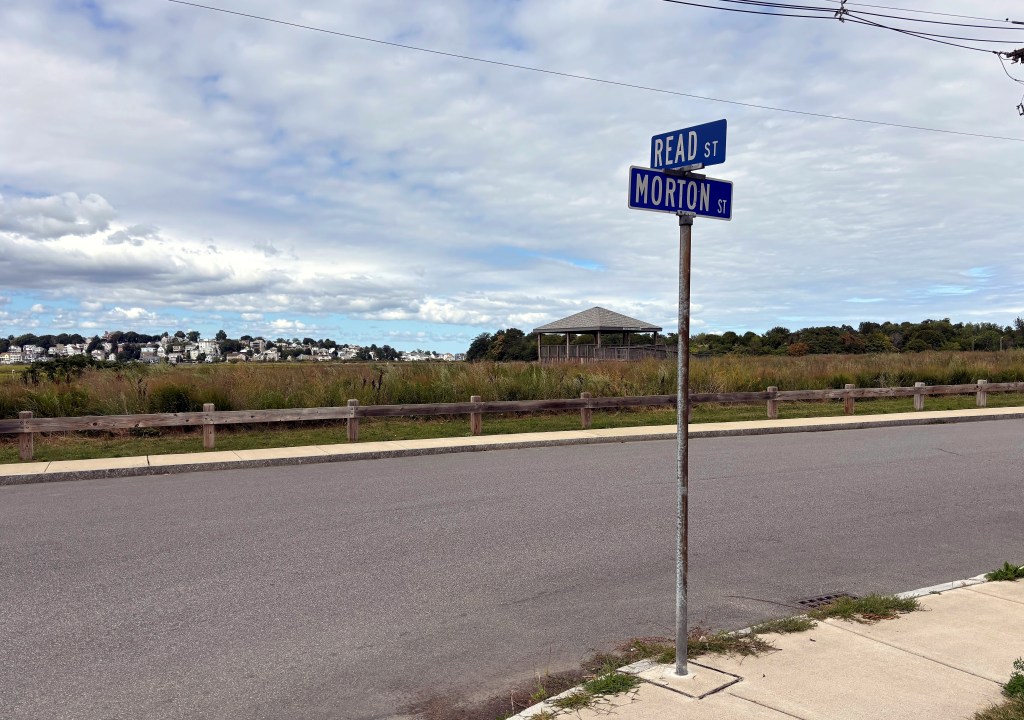
The Morton Street area regularly suffers flooding, and is ranked by the town’s Citizens Advisory Commission on Climate as the top “hot spot” among nine locations in Winthrop most urgently needing protection from rising water levels due to planetary warming.
The lost-grant notification comes just days after the Massachusetts Safe Routes to School program told Winthrop officials the town also cannot apply for its funding, which finances projects to help children get safely to school.
It’s part of a mounting toll for Winthrop taxpayers arising from a political campaign by a small group of activists in Winthrop and the Boston area to convince Winthrop officials to disobey the state housing law.
The 3A law, passed almost unanimously by the state legislature in 2021, requires cities and towns with MBTA service – meaning nearly all in the Boston area – to allow more multifamily housing in parts of their communities, or face cuts in state aid.
The state has the long-established constitutional right to set such zoning rules. And unlike many if not most towns, Winthrop can comply with 3A without actually adding any new housing, because it has three parts of town containing multifamily housing that can be rezoned to reflect that existing reality.
Taxpayers left to pay costs of political message
Yet opponents on the Town Council – encouraged by the council’s president, Jim Letterie, and the town’s state representative, Jeff Turco – have chosen not to take that option. Instead, they have argued that it’s worth subjecting Winthrop taxpayers to the lost state aid and potential legal costs as a way of symbolically protesting the state law. Both have promised to keep finding ways to appeal or overturn the 3A law, even though courts have already affirmed it.
And locally, the 3A opponents just waged and failed at another campaign to expel another member of the Town Council who supported the plan to comply with 3A without adding any new housing in Winthrop. That removal campaign against the council member, Max Tassinari, lost overwhelmingly, with its proponents managing to collect only about 70 percent of the signatures they needed townwide on a recall petition.
Many of the 3A opponents have argued that the cost of 3A lawbreaking will be low for Winthrop, contending that the town doesn’t pursue large amounts of state money.
“We really haven’t received a ton of revenue over the years in grants that are specific” to 3A law disqualifications, Mr Letterie said last month on the WCAT program Winthrop and the World, in response to a question about the financial effect.
Yet Representative Turco, in a written response to the state’s notification this week about the town’s ineligibility for the student safety funds, acknowledged that the mounting losses are real.
“These threatened grants are grants Winthrop actually receives each year,” Representative Turco said in a note to Cheryl McCormick, the assistant town manager of Winthrop, who handles grant applications to the state.
Frustration rises up again on Morton Street
Other recent state grant awards that Winthrop has won – prior to the Winthrop Town Council’s formal refusal to comply with the 3A law – include a $225,000 award for the town library. That money – equivalent to about 30 percent of the library’s annual operating budget – was used to build new access ramps at the library and to maintain the building’s elevator system. Town officials also are considering options for state aid as part of the $38.5 million fire station project approved by Winthrop voters in April.
The lost grant Municipal Vulnerability Preparedness program, meanwhile, would have continued work started in 2021 that included storm surge and sea-level rise protection, flood mitigation, and water quality and biodiversity improvements. Its requested value was $819,829, according to town officials.
The news that Winthrop has lost a chance at that money, as a cost of its decision to politically protest the 3A law, is raising frustrations among residents of the Morton Street area whose homes often flood.
One resident of the area, who identified herself only as Jennifer, said she has been asking town officials for a contingency plan for replacing the state money but not getting any answer. “That’s irresponsible,” she said. “If there is no plan for Morton without grants, then there is no real plan at all. What are we expected to do now?”
The 3A opponents, meanwhile, are persisting with their wide-ranging campaign, saying they now plan to try to overturn this week’s loss of their recall effort against Mr Tassinari. The opponents repeatedly acknowledged throughout their recall campaign that they needed 2,863 signatures – or 20 percent of the town’s registered voters, as stated in town regulations – to force a townwide ballot question on Mr Tassinari’s removal. Yet after collecting fewer than 2,000 signatures, the group led by attorney Diana Viens immediately switched its position to argue that it only needed 882 signatures, representing just the 20 percent of votes cast in the most recent town election.
But Winthrop’s town clerk, Denise Quist, rejected that interpretation in both social media and email responses, saying that the town’s recall rules clearly require signatures from 20 percent of the town’s registered voters, and confirming the defeat of the recall effort. In a response to a social media posting that presented Ms Viens’s claim of the lower signature threshold, Ms Quist answered flatly: “This statement is untrue.”


 Winthrop Pilot
Leave a reply to Enough Cancel reply