
Winthrop town officials apologized for any confusion surrounding the latest round of property tax bills. Citizens were surprised to see the rate increases associated with the override vote appear in the bills for the final two quarters of the 2026 fiscal year. These bills are disproportionately large because the full-year cost was applied to six months, as opposed to 12 months, of billings.
After getting deluged by questions and complaints from residents wondering about unexpectedly large increases in their January quarterly tax bills, the town manager, Tony Marino, came before the Town Council this past Tuesday indicating that, in hindsight, the town could have sent a letter along with the bills to ease taxpayers’ shock.
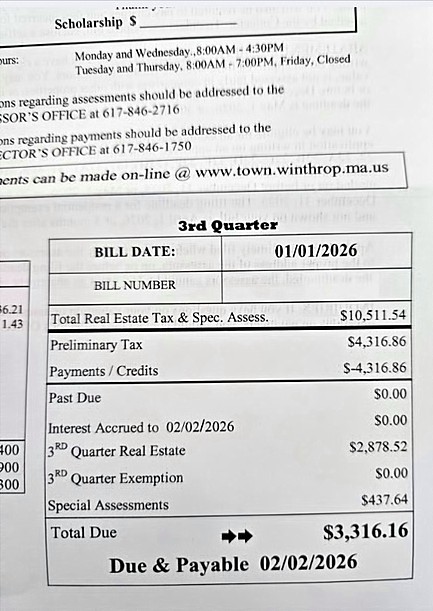
Annual Increase Applied to Half a Year
Last April Winthrop residents approved a $38.5 million expenditure for a new fire station, and a nearly $5 million per year increase in spending for schools (a 2.5 override).
Winthrop’s fiscal year begins July 1st, however the approved increase was first applied to this month’s property tax bills, the third quarter of the fiscal year. Because town officials are applying the full-year increase across the last two quarters of the fiscal year, most residents saw large increases to quarterly bills that will not be sustained, Mr. Marino said.
As an example, the median value for a home in Winthrop is $738,500. Last fiscal year, 2025, the annual taxes on this house were valued at $7,275, or $1,819 per quarter. With the increases approved to support level funding of Winthrop schools, the property tax bill for the same house for the current 2026 quarter is $2,294, because the annual payments are distributed across two instead of four quarters. In July 2026, commencing the 2027 fiscal year, Town Manager Marino said the tax payment for the same house will be $2,057 per quarter, based on the home’s new annual tax rate of $8,226. Doing the math across both fiscal years, this new rate is in line with the town government’s promise that the override would only add about $950 per year to the average residential tax bill in Winthrop.
That increase, however, does not yet include increases coming for the fire station project – which itself has some cost questions to be worked out.
Financing uncertainty
Preparatory work at the new fire station site is underway, however taxpayers should not see the effects of its cost until next year, when the town has to pay $147,000 in interest on project-related borrowing, Mr. Marino said. The fire station cost to taxpayers “will be minimal for now,” before ramping up as construction proceeds, he said.
One unresolved issue is that of state funding, given the Town Council’s refusal to comply with the state’s 3A law requiring new zoning for multifamily housing. State lawmakers approved the idea of giving Winthrop $2 million to tear down the existing school building at the fire station site – the result of a budgetary earmark authored by state Senator Lydia Edwards – but that allocation may be among the state funds covered by 3A-related restrictions.
When asked by Town Council member Max Tassinari for an update on that situation, Mr. Marino acknowledged the ongoing uncertainty.
One of the concerns, Mr. Marino said of his discussions with Healey administration officials, is that the town needs to be “in compliance with all laws,” and the town’s town’s non-compliance with 3A could be an issue. The town manager added: “We’re working the political back channels to try to get some support for it.”
Winthrop children may inevitably pay the price
Winthrop is now among the fewer than 10 towns, that are still refusing to comply with the 3A law. Officials in Tewksbury, one of the other noncompliant towns, announced last month that at least three state grants, totaling $350,000 for their schools, are being blocked due to 3A restrictions.
In response to questions about Winthrop’s circumstances, state officials said the 3A law allows the state some discretion on withholding school-related funding, but they declined to outline any specific decisions regarding Winthrop’s schools. Winthrop school officials said they had not been given any clarity on the matter.
Town officials already have been told that Winthrop is ineligible for grant money, as a result of 3A, that could have been used to support town infrastructure, including protections from rising sea levels, tree planting, and helping students travel safely to school.
Mr Marino spoke at a Town Council meeting where its newly elected members had been sworn in – representing a slate that emphasized in the campaign its intention to keep fighting against 3A compliance. Elsewhere, however, the issue is showing signs of losing attention, including the failure of 3A opponents in Winthrop and beyond to place a referendum question on the 2026 statewide ballot aimed at repealing the 3A law.
The new Town Council also unanimously elected Suzanne Swope, the councilmember representing Precinct 4, as their new vice president.

 Winthrop Pilot
Leave a reply to Kathleen Cappuccio Cancel reply