
After a year-long stare-down, town and state officials are showing new signs of possible compromise on the 3A housing dispute, with the Town Council’s surprise aversion to legal confrontation being followed by the state’s declared willingness to better refine potential repercussions.
Among the shifts, top state officials have reportedly told their Winthrop counterparts that they will study the question of whether 3A-related zoning changes affect condominium rules, and that they are unlikely in the end to impose 3A-compliant zoning revisions beyond what town leaders would prefer.

And the Massachusetts state senator representing Winthrop, Lydia Edwards, in a move toward the position of 3A-compliance opponents, said that she rejects the idea of enforcing the 3A law by imposing restrictions that affect schools and their children.
Those developments followed the Winthrop Town Council session earlier this month, on February 3, in which the council – almost uniformly elected in November on a promise to fight the 3A law – surprised 3A critics by declining to back a private lawsuit against 3A aimed at expanding Winthrop’s fight with the state over the matter.
Encouraging signs
Updating the council Tuesday, Mr Letterie said he took encouragement from a talk he had with state officials in Boston between the two council sessions. “It was a very healthy meeting,” Mr Letterie said of the February 9 encounter with the Massachusetts Secretary of Housing and Livable Communities, Edward Augustus Jr., and other local and state officials. “They were very receptive to everything we said,” he said of the state officials.
Senator Edwards, speaking earlier Tuesday on WCAT’s Winthrop and the World program, gave a similar bottom-line assessment. “What I heard consistently,” she said, referring to the Augustus meeting, “is that there are no closed ears or doors to Winthrop, that the channels of communication are continually open, and wanting to work with us as much as possible.”
Along with the more positive talk, however, the political environment over the 3A law still includes a lack of firm commitments from either side, renewed talk from Mr Letterie of a townwide referendum on the law that wouldn’t remove the state requirement even if it manages to pass, suggestions of higher taxes, and fissures in Mr Letterie’s anti-3A slate resulting from the February 3 council vote.
State officials declined to speak on the record about their movement on the topic, beyond generally acknowledging their interest in finding a way of bringing Winthrop into compliance on 3A.
Schools exemption
The 3A law was passed nearly unanimously by the state legislature in 2021. It required 177 cities and towns in eastern Massachusetts to add zoning for more multifamily housing, ideally near transit, to reduce crises involving the state’s insufficient levels of affordable housing and its heavy reliance on the use of private motor vehicles.
Winthrop could have complied more easily than most towns, because it has multifamily housing built in areas not yet classified as multifamily zones. But Mr Letterie led a campaign of opposition that helped his council candidate slate win November’s elections while leaving the town increasingly isolated – fewer than a dozen of the affected towns remain non-compliant – and facing both lost state aid and the prospect of legal action.
Senator Edwards, while a leading advocate of Winthrop’s compliance with the 3A law, did call in the WCAT interview for the state to exclude education from any 3A-related aid cuts. Winthrop already has been told that it is ineligible due to 3A to obtain money from the Massachusetts Safe Routes to School program, and Senator Edwards warned of the possible loss of 21st Century Community Learning Centers grants, a federally funded state program for afterschool teaching that could be worth $400,000 over three years.
“I do think that there needs to be a minimum standard” for cutting off state aid due to 3A, Senator Edwards said on WCAT. “If the town of Winthrop is not complying with a zoning mandate, then I don’t know that you should be cutting off their education money,” she said, reflecting a sensitivity to how much pain the state should expect to impose on recalcitrant towns. “You shouldn’t do it,” she added.
Rule clarity
Senator Edwards also agreed that state officials, in enforcing the 3A law after waiting five years for towns to comply, perhaps could be clearer on the rules. The state legally retains the full right under the state constitution, as affirmed by state courts, to set whatever zoning terms it pleases. But as a practical and political matter, she suggested, the state doesn’t necessarily want to do that as a standard rule of operation – or leave towns unclear on the exact guidelines and repercussions.
In particular, Senator Edwards described the ongoing uncertainty over the fate of a $2 million earmark she obtained in the state budget process, to help fund the teardown of the former school facility where the town’s new fire station will be built. The state cannot fund all the earmark allocations that lawmakers insert into the state budget, Senator Edwards conceded, but the state also has not yet been clear on whether Winthrop’s refusal to comply with the 3A law is a factor to any degree.
Mr Letterie announced the February 9 meeting with state officials at the same council session on February 3 where he and two new council members who also campaigned against 3A compliance – Kurt Millar and Kim Dimes – joined at-large council member Max Tassinari to defeat the idea of joining the private anti-3A legal action.
The Town Council president said he asked state officials including Secretary Augustus – whose office oversees the 3A law – to be as specific as possible with Winthrop about which state grants will or will not be affected by 3A. “We said we’re big boys and big women and we understand that there were consequences,” but want to know the details of those consequences, Mr Letterie told the council.
Future consultations
State officials promised during the meeting, Mr Letterie said, to give clearer answers about a long-running contention of 3A opponents in Winthrop – the idea that changing the zoning of Seal Harbor to multifamily status would somehow change the rules governing its condominiums. That possible harm has been repeatedly put forth by the Town Council’s current vice president, Suzanne Swope, and her daughter, Diana Viens, a leader of the anti-3A campaign in town. The state attorney general, however, already had published an opinion making clear that the 3A law doesn’t require any changes in leases or home owner association contracts.
The state officials also gave specific assurances, Senator Edwards said, that they don’t plan to use Winthrop’s existing state of 3A violation to impose on Winthrop anything other than the zoning plan – changing to multifamily status the three parts of town with existing multifamily development – that town officials consider least disruptive.
Mr Letterie also raised the possibility of seeking another town-wide vote on the 3A question, even though state courts already have made clear that the state holds overall authority on zoning questions, and referendum attempts on the state and local level have failed or been abandoned.
Mr Letterie said there will be at least one more meeting with state officials to confer on the matter, and he promised to resume a regular series of question-and-answer sessions that he previously held with town residents.
Advocates of town compliance with the 3A law praised the sign of movement. “I’m heartened that the council president is now making efforts to communicate” with Secretary Augustus, said Cassie Witthaus of the community group Winthrop Working Together. “I wish it had not taken this long.”
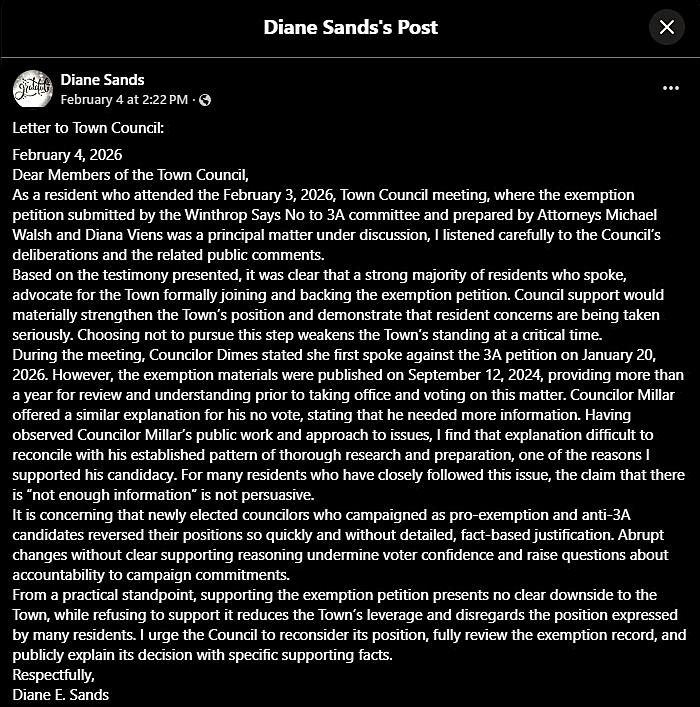
And residents who have been more alarmed by post-election shifts toward compromise on the 3A law have begun using the council sessions and other public forums this month to castigate their erstwhile allies on the matter. “Choosing not to pursue this step weakens the town’s standing at a critical time,” one of them, Diane Sands, said in a social media posting of the council’s refusal to join the anti-3A lawsuit.

 Winthrop Pilot
Leave a reply to reallyagile9053cd5fc0 Cancel reply