
A heavy winter storm caused chaos and distress across Winthrop on Monday, with 15 inches of snow and 60 mph wind gusts magnified by widespread power outages that took down water supplies for large sections of town and exacerbated questions about its utility preparations.
The storm came one month after Winthrop was hit with about two feet of snow, though this week’s duration, wind effects and extended outages suggested the possibility of longer-lasting effects on the town and its residents.
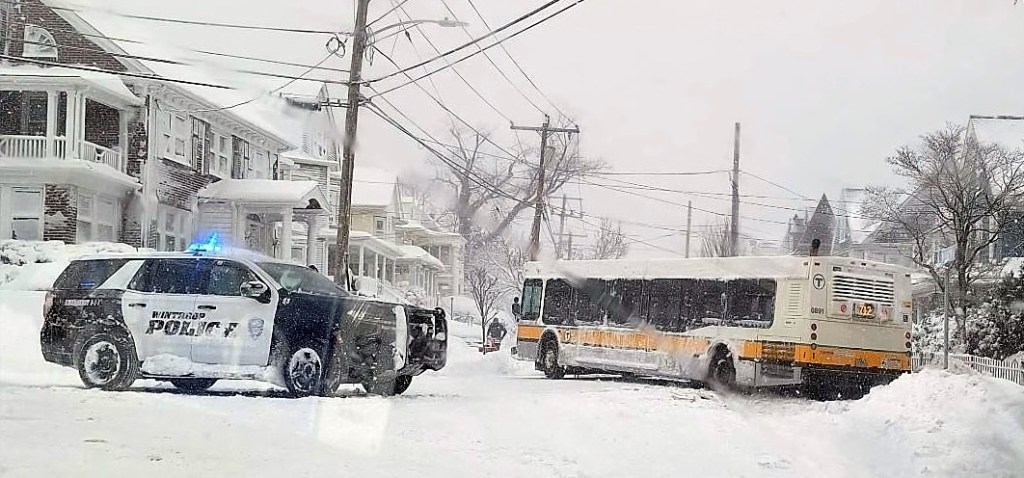
The storm knocked out electricity to about a quarter of Winthrop’s 8,500 households, making it one of the most heavily affected communities in the Boston area. Those outages in turn were blamed for triggering several instances of outages in Winthrop’s water supply, which relies on the power system for its operation.
Inexcusable delays
The results included several inches of water inside houses in the area surrounding Girdlestone Road – already one of the town’s hardest-hit areas in terms of ongoing flooding – and water along the streets.
“This is just inexcusable as far as I’m concerned,” one of the affected residents, Mark Sennott, said in appearances on local television stations. “This is infrastructure that should have been fixed decades upon decades ago,” Mr Sennott said. “I’m fed up with it.”
The damage in the area included a sinkhole that broke open on Marshall Street, blamed on one of the water main breaks, that trapped a truck from the town’s Department of Public Works as it was plowing.
The Town Council president, James Letterie, issued a statement during the storm declaring a state of emergency, noting the town “will require and request state resources” to help in managing the storm.
State role
The town, in two separate statements, also noted multiple water main breaks and attributed them to the power loss, which it said also affected about 1,500 homes in Winthrop. And it announced the opening of a warming center at the Arthur T. Cummings Elementary School for anyone needing it.
Beyond the written statements, however, town leaders did not respond to requests for comments on the situations. One member of the Town Council, Max Tassinari – who stood on opposite sides of Mr Sennott and Mr Letterie as they both fought town compliance with the state’s 3A law and castigated Mr Tassinari’s support for it – expressed broad agreement with Mr Sennott’s concern about the storm revealing failed priorities.
Mr Tassinari, an at-large member of the council, said the storm showed that the town’s public works, fire and police departments “continue to overdeliver in every circumstance,” adding: “They responded as fast as possible to address water, power and heating issues across town amidst a record-breaking blizzard.” But the damages in the Girdlestone area, Mr Tassinari said, show the mistake of the town fighting the state over the 3A issue and missing out on some $15 million in state funding that could have been used to help with flooding and drainage problems.
“If the town had moved on the known drainage issues at Girdlestone with that available state funding at any time in the last eight years, we wouldn’t have had that level of catastrophe today,” Mr Tassinari said. “Instead we spent two years fighting against the state and still have limited access to funding because the town chooses to treat the state as an adversary instead of a partner.”
Key area
The Girdlestone Road neighborhood already had been subject to repeated flooding that earned it the distinction of being named by the town’s Citizens Advisory Commission on Climate as one of Winthrop’s locations most vulnerable to rising sea levels. The commission said the area needed new protections that included walls and pumps, but it suspended its work after accusing the Town Council of failing to obtain necessary funding while hindering state cooperation through Winthrop’s rejection of the 3A housing law.
The storm hit harder to the immediate south of Boston and Winthrop, with winds reaching 80 mph and snowfall totals nearing three feet. Massachusetts Governor Maura Healey issued a travel ban for Bristol, Plymouth, Barnstable and Dukes counties, and sent 200 members of the state’s National Guard to assist with the response. About 290,000 power customers lost service statewide.
In Winthrop, the power outages were largely in the areas of Point Shirley and the Central Business District extending out to the Highlands. The water outages were then triggered by the loss of power to the instruments that control the water system’s pressure relief valve stations, opening the valves, the Winthrop town manager, Anthony Marino, said in his written explanation of the situation.
“This resulted in a pressure spike that led to numerous water main breaks, including in the areas of Marshall Street, Veterans Road, Beal Street, and additional locations,” Mr Marino said. For a brief time, he said, the town shut all water service in Winthrop. The DPW truck was removed from the Marshall Street hole in the early afternoon, and much of the power was restored by early evening.


 Winthrop Pilot
Leave a reply to agile3d8812d953 Cancel reply