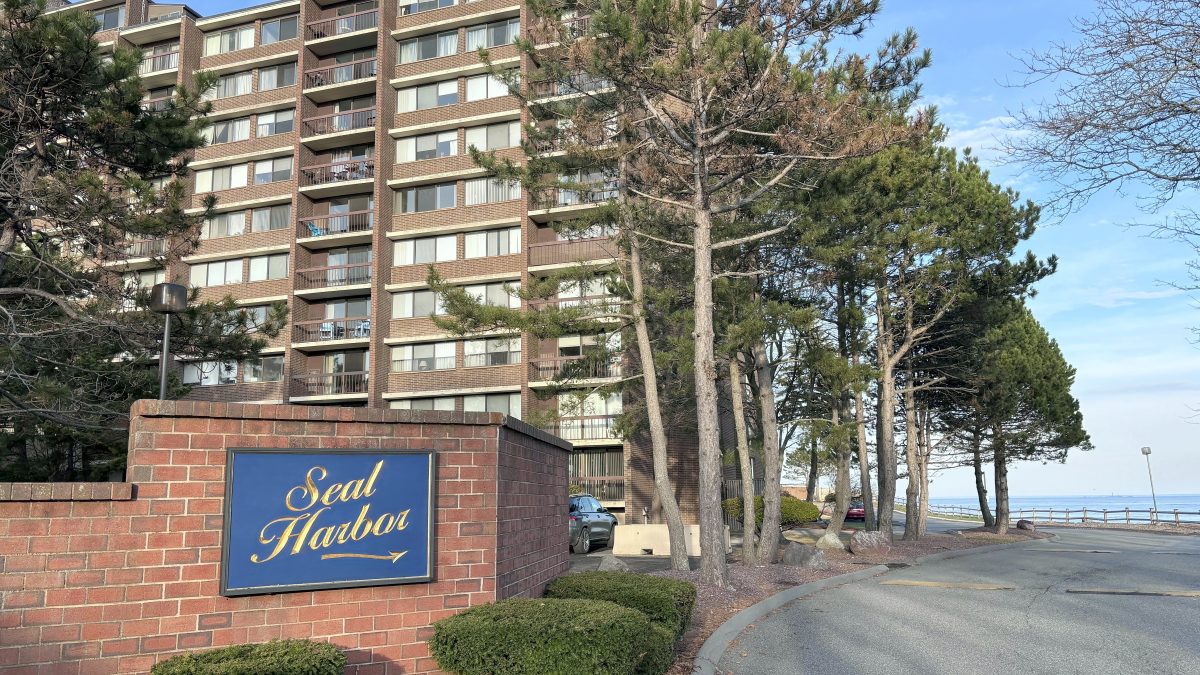
Massachusetts officials, in a formal response to Winthrop town leadership, reiterated that the 3A housing law does not interfere with rules at condominiums such as Seal Harbor and suggested that fact is now so clear that its continued repetition represents a disinformation campaign being waged against 3A by its opponents.
The state’s Executive Office of Housing and Livable Communities, in a written response to the meeting the EOHLC held in February in Boston at the request of the Winthrop Town Council president, Jim Letterie, also reiterated the state’s fundamental right to order changes to local zoning regulations as necessary to keep communities in compliance with the 3A law.
Mr Letterie has amplified both concerns as part of a campaign he has led, with a mix of political success, against 3A, which requires most cities and towns in eastern Massachusetts to add zones that allow multifamily housing. The issue helped Mr Letterie and allies win the Town Council election in November, but has cost the town grant money and legal fees, and produced no victories against 3A.
Persistent disinformation
Winthrop is now among only about a dozen non-compliant communities, even though it would be relatively unaffected by the law because of its ability to rezone Seal Harbor and other sections of town already covered by multifamily housing. Yet Mr Letterie has argued that Winthrop should keep fighting – and incurring the associated costs – as a way of expressing discontent with the state’s constitutional right to decide zoning rules.
As part of that argument, Mr Letterie has echoed the suggestion made repeatedly by the council’s vice president, Suzanne Swope – a resident of Seal Harbor and mother of the Winthrop resident leading the anti-3A campaign – that town compliance with 3A might somehow alter the documents signed by Seal Harbor and its residents governing what they can do with their property.
The EOHLC, writing last week to Winthrop’s town manager, Anthony Marino, said that condominium rules in Massachusetts are governed by a state law numbered 183A that the EOHLC has no authority to change or override. And in the April 15 email, the EOHLC’s undersecretary for livable communities, Chris Kluchman, cited blunt new language from the agency condemning the persistent repetition of false claims to the contrary.
“While disinformation covers a wide variety of land use and municipal subject matters, a common tactic deployed by opponents has been to tell current residents that they will lose any benefits they derive from recorded deed restrictions, or even that they will be evicted from their homes if new zoning is adopted where they live,” the EOHLC said in an updated 3A guidance document that Ms Kluchman cited to Mr Marino.
State rights
“Municipalities are encouraged to clarify to residents what the attorney general’s office has already made clear: that changes to local zoning do not impact deed restrictions or cause evictions to current residents,” the agency said in the guidance document.
Mr Letterie raised the matter at the February meeting with Edward Augustus Jr., then the secretary of the EOHLC. The Winthrop Town Council president had publicly described the meeting with Mr Augustus as an opportunity to press his claim that the town should somehow be exempt from the requirements of 3A. Mr Augustus later resigned his state government position, to lead a bank in the private sector, and Mr Letterie has been seeking a follow-up meeting with his successor as secretary, Juana Matias.
In her written response to the concerns Mr Letterie raised in February, Ms Kluchman also issued a clarification that reflected Mr Letterie’s complaint that the 3A law gave the EOHLC the authority to “change rules” governing 3A implementation. In it, Ms Kluchman affirmed that the EOHLC can change a community’s status on compliance with 3A if the agency finds new information that affects that determination. In a section of 3A guidance that said the EOHLC can “require” the necessary changes, the revised guidance cited by Ms Kluchman now says that the EOHLC can “require the town to make” the necessary changes.
Mr Letterie, in two public discussions of the matter last month, suggested that he was advancing the two arguments without actually accusing the state of being wrong on either. Asked on March 12 why the state’s assurances on condominium documents weren’t acceptable, he answered: “I’m just telling you, it’s not for a lot of people.” Asked on March 26 why the state doesn’t have the right under 3A to adjudicate compliance with the law, he answered: “I’m not saying that they don’t have the right.”
Enduring fight
Asked why then he was raising such objections, Mr Letterie answered: “To me, you have to maintain your principles, and to me 3A is a bad law, and I’m going to fight it as best I can.”
Winthrop’s town counsel, James Cipoletta, has acknowledged 3A does not affect condominium documents, and characterized as minor the EOHLC’s newly revised language on its right to judge 3A compliance.
Mr Letterie was part of a slate of candidates for the Winthrop Town Council that won a clear majority of votes in this past November’s election after repeatedly promising to fight the 3A law. But that alliance shattered in the following months, leading to open arguments at the April 7 Town Council meeting over whether the town should expand its legal battle with the state by joining a lawsuit led by Ms Swope’s daughter, Diana Viens, arguing that Winthrop deserves an exemption from the 3A law.
The Town Council then voted at its April 14 meeting for Winthrop to join that lawsuit, with Ms Swope on the winning side of a 5-3 vote in favor of the idea. But because the town’s governing charter doesn’t let the Town Council explicitly demand that the town manager take such a step, the resolution was first re-worded to request rather than order Mr Marino to do so.
Follow-up decisions
Just ahead of that Town Council vote, Mr Cipoletta urged caution about joining the case, citing its likely cost and duration, and raising questions about the reliability of the private group bringing it. Yet he and Mr Marino gave general assurances of their willingness to comply with Town Council requests.
In response to a question Sunday about his plans for handling that request, Mr Cipoletta declined comment other than to say he was preparing “a draft of an intervention motion” for Mr Letterie and Mr Marino to review.
Mr Letterie has repeatedly asked the EOHLC for a follow-up to the February meeting. Ms Kluchman’s response made no reference to the idea.
The 3A law covers 177 cities and towns near MBTA service. Winthrop appears to have lost or been made ineligible for about $2.5 million in state aid due to its 3A position, Mr Marino told the Town Council this month. The town has not provided an estimate of the legal costs of the court action.