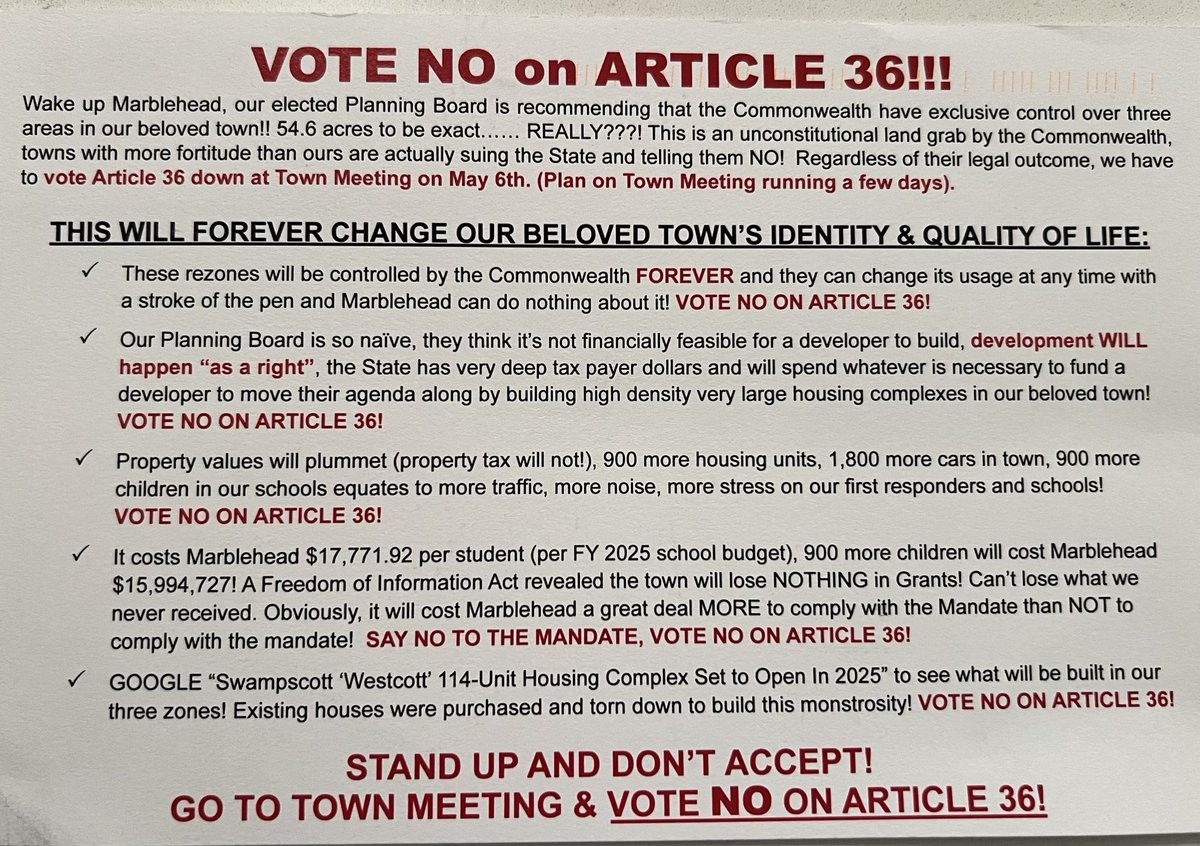
The Massachusetts attorney general is promising a review of Marblehead’s attempt at technical compliance with the 3A housing law, raising new legal and political complications for Winthrop’s own defiant position.
Just days after Marblehead – a nearby coastal town of similar size to Winthrop – approved a 3A compliance plan that uses a local golf course to meet the letter of the law’s zoning expansion demand, the state attorney general, Andrea Joy Campbell, promised scrutiny of the move.

If state housing officials approve the Marblehead plan, Ms Campbell said Tuesday on WGBH radio, the attorney general’s office will see “if there’s any legal recourse we can take.”
Compliance options
The comment raises the possibility of new difficulties for Winthrop, which is one of the few remaining communities in eastern Massachusetts that have declined to comply with 3A and instead face the resulting losses in state funding and ongoing legal action from the attorney general’s office. That’s because Winthrop officials have acknowledged that even if they did comply with 3A, they too would put forth a plan expressly designed to avoid actually adding new housing.
The potential 3A compliance plan for Winthrop drafted by the town’s Planning Board would avoid adding new housing by converting to multifamily status the land under several existing complexes that already have multifamily buildings. The Winthrop Town Council has twice voted against submitting that plan to the state, with council members arguing that even that level of technical compliance would feel to them as too great an act of submission to state authority.
At the same time, Ms Campbell’s vow of scrutiny for Marblehead has its own complications. Many of the eastern Massachusetts communities that already have complied with 3A also adopted a strategy of adding their multifamily housing zones in places that make the addition of new housing units very unlikely.
And the state housing agency, the Executive Office of Housing and Livable Communities, which formally assesses each town’s 3A compliance plan, has given indications that it regards the 3A law as only requiring the creation of new multifamily zones, without including any demands on towns that the new zones lead to actual housing.
Moment of attention
Yet even in that atmosphere, Marblehead’s compliance process stands out as especially provocative. Town officials intentionally placed most of their required multifamily zone in a golf course in town, then admitted their expectation that meant that no housing would be built there.
As part of that, in a moment that gained notoriety well beyond Marblehead, a resident stood before the Town Meeting, moments before the town’s plan was approved on May 4, and mocked the move as a charade. In a clip of the exchange that has drawn millions of views, the resident, David Modica, asked why towns shouldn’t add housing for people who need it, and suggested that his own fellow residents were “kinda being pricks” by ignoring that need.
The video clip initially was posted online by Jonathan Berk, the chair of the board at the advocacy group Abundant Housing Massachusetts. In it, a member of Marblehead’s Planning Board, Mark Liebman, freely acknowledged to Mr Modica that the choice of the Tedesco Country Club was designed to thwart 3A’s intent, after town voters previously rejected multifamily designations in areas more plausible for development.
The 3A law – also known as the MBTA Communities Act – was passed almost unanimously by the state legislature in 2021, purportedly as a means of expanding housing around Boston while directing its placement in locations relatively near existing MBTA service lines. Opponents of compliance – in Marblehead, Winthrop and other towns – have questioned the existence of a housing crisis and cited fears that new housing in their communities would add congestion and costs. Some, however, also have offered broad negative claims about overall economic implications and have falsely denied that the state has a fundamental right to set zoning rules when it chooses to.
Fair treatment
In her appearance on WGBH, the state attorney general spoke of the need to treat fairly the communities in eastern Massachusetts that already have accepted the intent of 3A. “We recognize there is a housing crisis,” Ms Campbell said. “The MBTA communities law is one tool to help,” and “we’re going to keep enforcing it,” she said.
Regardless of how the state manages its legal battle with towns such as Marblehead and Winthrop, the national attention commanded by Mr Modica’s brief and forthright exchange with Mr Liebman helped put an extraordinary level of attention of a housing system that is “deeply broken,” Mr Berk said.
Legally, Mr Berk said, the state probably can’t disqualify the 3A compliance plans that Marblehead and many other cities and towns around Boston devised as ways to only technically satisfy 3A’s terms. One result, he acknowledged, is that the 3A law so has far accounted for only about 8,000 new housing units – a fraction of the 200,000 new units that 3A’s advocates had envisioned, and which Massachusetts Governor Maura Healey has said the state needs.
But 3A never was intended to solve, by itself, the state’s housing problems, Mr Berk said. “Massachusetts built a deeply restrictive housing system in the 1970s, and we still largely operate under that framework today,” he said.
Public opinion
“Housing is a systems problem, and the entire system in Massachusetts is broken: zoning, layered permitting processes, building codes, code enforcement, financing structures, and more,” Mr Berk said. “Until we approach housing as the interconnected systems challenge that it is, instead of relying on isolated reforms every few years, we will never adequately respond to the scale of this crisis.”
Part of the solution is public education, Mr Berk said. A survey last year by Abundant Housing Massachusetts found that some 80 percent of respondents in the state support broad action to build more homes statewide, he said. Yet 3A opponents have engaged in “conspiracy theories, misinformation, and fearmongering” about the actual effects of the 3A law, Mr Berk said.
In Winthrop, the vice president of the Town Council, Suzanne Swope, has repeatedly claimed – despite state assurances to the contrary – that attaching a multifamily zoning designation to one of the existing complexes, the Seal Harbor condominiums, where she lives, would somehow expand the ability of its apartment owners to add residents.
As a result of such objections, some residents and officials in town have suggested drafting alternative 3A compliance plans that would put the multifamily zones in other locations, including the town’s golf course and land at Logan International Airport that is officially considered part of Winthrop.